Archive for June 2009
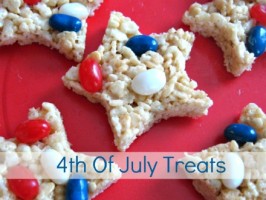
Today is Canada Day and Fourth of July is just a few sleeps away . What is a holiday without treats? Last year we made these adorable flag cupcakes and this year we made the Star Treats that were gobbled up at church. Do you have a favorite treat? Leave a comment and share! To all my fellow Canadians, Happy Canada Day!Star Treats
- Gather your materials. You will need 5 1/2 cups of marshmallows, 5 1/2 cups of rice crispy type cereal, 1/4 cup of butter, some non stick spray , a large sauce pan , a baking sheet and a star cookie cutter, and red , white and blue jelly beans.

- Make your rice crispy squares by melting the butter over medium heat, add the marshmallows melt them add the cereal. Spread onto your baking sheet and cool just enough for them to be comfortable for your child to touch.
- Time to add the jelly beans. We counted them as we put them in , and surprisingly few ended up in his mouth.

- Pop them in the fridge and cool completely.

- Grab your star cookie cutter and cut out.

- Enjoy!

- Gather your materials. You will need your favourite ( another Canadian spelling, not an error) cupcake recipe , some jelly beans and white icing.
- Bake your cupcakes and let them cool completely. Your kids can help but mine had his fair share of jelly bellys while I was making the batter, so I did this activity alone.
- Ice the cupcake completely.
- For the Maple Leaf cupcakes start by making a maple leaf with 6 red jelly beans. You can also use licorice or another red candy.
- Next add 3 red jelly beans lengthwise on either side of the maple leaf! Sing O Canada before eating
- For the Stars and Stripes Start with a horizontal row of 4 red jelly beans , repeat.
- Add 4 blue jelly beans in the upper left.
- Add 2 rows of 2 red jelly beans , sing The Star Spangled Banner before eating
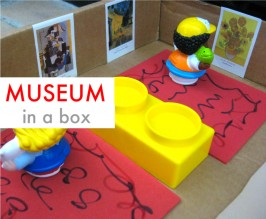
I love museums, specifically art museums. My son has been really into the Mona Lisa and Birth of Venus since I bought him the first book in the reviews at the Vancouver Art Gallery. He also keeps asking to go to the Louvre after seeing an episode of Little Einsteins, don’t I wish! So while he was napping on Sunday I made him a museum, kids could be a part of this for sure – instead of using masterpiece stickers you could make your own art! It’s been played with multiple times since making it .
- Gather your materials. You will need a shallow card board box, some foam or construction paper in 2 colors, some markers, glue, scissors, art stickers, little people blocks and little people.

- Start by cutting your foam into rugs.

- Draw some fun squiggles to make the foam look like oriental rugs.

- Cut out a door.

- Cut a runner from the other color of foam.

- Add glue for the rugs and runner
- Pop them down.

- Time to add stickers- here is a close up of the stickers we are using. I found them at the St. Louis Art Museum ages ago but have seen them at the Vancouver Art Gallery .

- Add them to your box. The Mona Lisa is from the cover, I’d already used the sticker, I just taped it on.

- Add the furniture- I used a few blocks.
- Add your doorway. My son has been saying “Please pay for museum here” when he plays. If you have time you could make a little desk!

- Time to play.


Books!

“Babar’s Museum of Art” by Laurent de Brunhoff is one of my favorite art books for kids. My son has recently decided he hates it because he doesn’t want to see the elephant versions of the art. All the art in the museum are masterpieces that you will recognize redone with elephants. He slams the page in the way only toddlers with a definite sense of justice can and says ” No elephant paintings Mama, real ones!” Trust me though this book is awesome and he loved it a few months ago. The story is about how Queen Celeste wants to change the abandoned railway station into a museum to house all their collected art . The museum itself looks just like the Musee D’Orsay in Paris and the story also explains art for children.

“In The Garden With Van Gogh“ by Julie Merberg and Suzanne Bober is a little board book filled with easy rhymes and great art. The book doesn’t really have a story so much as a theme but it works. My son enjoyed it and asked to read it again after we were done. I like that books likes all these bring art into little hands for them to explore.
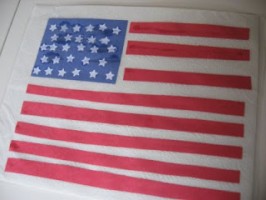
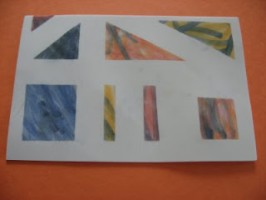
- Gather your materials. You will need a piece of paper towel, some red, white and blue paper, a star paper punch, scissors, glue and contact paper.

- Start by cutting your blue paper into a square that takes up almost a quarter of the upper left corner of your paper towel.

- Cut your red paper into stripes, some long, some short.

- Punch stars out of your white paper

- Add glue to your blue

- Add the stars

- Add glue for the stripes and start adding them.

- Let dry ( do not skip this step, you’ll get squished glue marks like me, learn from my oops).

- Cover with contact paper. The way that works best I think is to place on piece of contact paper on your table , lay the flag face down so there are no bubbles, then sandwich it with another piece. Press hard and trim.


” How to Make an Apple Pie and see the world” by Marjorie Priceman cost me a total of 15 cents at a thrift store. It is worth so much more than that. This book is a gem! Perfect for older preschoolers who are getting a sense of the world beyond their own home and city, this book takes you on a ride around the world! You follow the little girl to Italy, France , Sri Lanka, England, Jamaica and back to Vermont! As soon as I read this my mind was racing with classroom activities ! I will be posting some soon. I LOVE this book, I just wish I had read it when I was still teaching it would have been so much fun to teach geography with!
“How to Make a Cherry Pie and see the USA” by Marjorie Priceman didn’t disappoint one bit. I was worried after falling in love with the previous book that this couldn’t live up to my expectations. It did! This time she wasn’t looking for ingredients for the pie, but rather materials for her tools. She gathered wood in Washington for her rolling pin, cotton in Louisiana for pot holders granite in New Hampshire for her pastry slab and more. What I wasn’t expecting of this book and loved was how she gathered natural resources and then processed them to make what she needed. I think this is a wonderful lesson about manufacturing and could be used for a launchpad for learning about so much more. Another gem I will be adding to my must buy list.
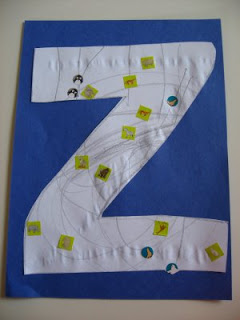
- Gather your materials. You will need a piece of white paper, a piece of construction paper, animal stickers, a crayon( or marker), scissors and glue. * Our stickers were a little small but the only ones we had on hand, if I did this again I would use much larger ones.

- Start by drawing a large uppercase Z.

- Hand it to your child and have them practice making straight lines, my son did a few before the urge to draw in circles overtook him. That’s fine the straight lines are good writing practice but at 2 I am not worried with specifics . The lines straight or curves will be the cage bars.

- Add your animals to the cage. I encouraged my son to put the animals inside the Z, most got in. This adds a quick in vs out lesson in opposites.

- Cut out.
- Add the glue
to the construction paper.
- Add your Z and let dry.
Books!
” Inside a Zoo in the City” by Alyssa Satin Capucilli is a rebus read along , so children who can’t read words yet can help read this with pictures put right into the text! The story is repetitive and builds with one animal and page at a time. Preschoolers love these books and the repetitive nature of it makes it interactive and fun!
” 1, 2, 3 To The ZOO” by Eric Carle is fun counting book perfect for toddlers. Actually as I type this my toddler is reading it. There are no words, just pictures and numbers and that makes it perfect for toddlers who are just learning both numbers and animals because parents can read it slowly counting , naming the animals and making the animal sounds, or more quickly just counting!
“Peek-a-Zoo!” by Marie Torres Cimarusti is a vibrant lift the flap book that goes through sounds different animals make while playing peek a boo with the reader. What I like about this book is that the flaps offer a chance for your baby or toddler to anticipate what animal it hiding as well as the sound , so it grows with them. Also the flaps are large enough that little hands can grab them and won’t get frustrated.
Pop over to FamilyEducation.com ! And read my reviews of even more Zoo books.