Posts Tagged ‘Color Recognition’
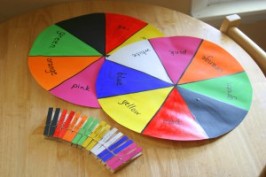
I get emails often asking for ideas based on materials so today I compiled some of our crafts that use clothespins. Our favorite is the Clothespin Dinosaur Craft above but over the years we have used clothespins for a whole bunch of learning.
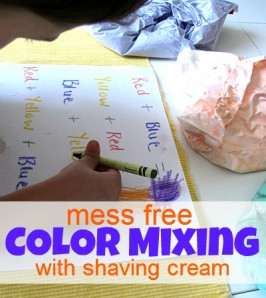
Doing projects with your kids is supposed to be fun for everyone, but when your kids are far apart in age it can be challenging. This project is perfect for different ages! Since having my daughter last year one of the most common questions I get is ” How do you craft with both kids?” Some days I do just a baby project, some days just a big kid one but there are times that we can all work together despite the almost 4 year age gap. This color mixing activity was perfect . They each had their parts and we had a blast being color scientists although if you ask my son his sister was his lab assistant not a full scientist, that is only for big kids.
- Gather your materials. You will need some good quality zip lock bags, shaving cream, some paper, crayons or markers, and food coloring.

- Start by making a simple chart showing the colors to mix , leaving the result blank. Make sure you have the correct color of marker or crayon available for the result. We made 4 colors, adjust the number of colors based on the attention span of your “scientists”.

- Add shaving cream to the zip lock. My son helped me with this step- he was so excited. I love when simple things make his day!

- Add the food coloring. We added 2 of each color but then increased it to 5. Look now they are counting too , I love when projects span many subject areas.

- Zip it up , making sure to squeeze out some air so when your “lab assistant” squishes it that the bag doesn’t pop.

- Squish! Until the colors are all mixed.
- She loved squishing, just watch they do not put it in their mouth. Whenever you are working with toddlers or infants you must always be within arms reach. Label the colors, use descriptive words while they explore.

- Come back and record the results by finding the correct color and completing the chart.

- Talk about the results. Ask if any colors were surprising , which color do they like the best and why?

Crafting, teaching or just generally parenting is different with multiple abilities but with a little effort you can find activities that can be done at the same time for every child in your care. We had a blast and another real benefit of a cooperative project like this is that your kids are working together something that isn’t always so easy to achieve.
This post is about a learning activity I did with my son, Charlie, but it’s also about working with special needs kids in general and how sometimes you might have to look at something differently to get the desired result. I wanted to share this activity with you all because it involved some problem solving, but in the end it was completely worth it. Working and teaching a special needs child can have it’s challenges, but when you can it right, you’re on top of the world.
For this activity we used:
- A piece of poster board or card stock
- markers
- colored dot stickers (Available on the stationery aisle almost anywhere)
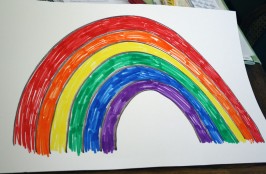
For this activity, I wanted to do something with a rainbow and colors. After spotting some “dot stickers” on the stationery aisle, I knew exactly what I wanted to do.
I drew a rainbow with a black marker on half a sheet of poster board. I then used those markers to color it myself–my son hates markers. Did spend a lot of time on it–just enough to make it very clear where each color should be.

We then took out the stickers and began places the stickers in the matching section of rainbow.
We started off guiding Charlie through the motions, waiting for him to start initiating some himself, but we weren’t getting a whole lot out of him. Then my husband remembered that Charlie has gotten very interested in other people’s hands–he likes to touch them, move them around, etc. So we switched things up. My husband held the sticker and asked Charlie where he should put it. Charlie immediately grabbed my husband’s hand and moved it to the correct place.
He did this nine times in a row–until it was clear to both of us that he had no trouble understanding matching. We were so excited to see that he not only understood the activity, but that he was pretty good at it too!
Working with a special needs child sometimes forces you to think outside of your comfort zone–consider different ways. Would it be great if my son could do this activity with no help from his parents? Of course, but in the mean time I want to keep stimulating his brain until his body catches up.
____________________________________________________________________________________________________________________________________________
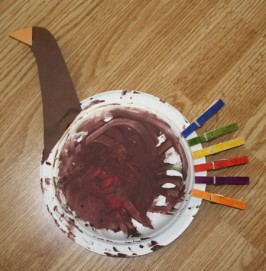
Katy is a mom of one who loves art, mystery novels, and anything involving peanut butter–she blogs about raising her little miracle at Bird on the Street.For this activity you will need a paper plate, clothes pins, brown and yellow construction paper, scissor, glue, and something to color with. For some reason I had craft confusion and used paint and markers, but that’s overkill.

First, make your paper plate brown–we finger painted because that allows us to work on sensory stuff at the same time. I’m seeing major progress in that my son will paint and also that he’s stopped trying to put the paint in his mouth. Little victories! 
Next, cut out a head and beak from the construction paper. Glue them to the plate.
Then you need to color your clothespins. I used markers and did it myself since it’s a little beyond Charlie’s abilities. If your child can do it by themselves, then let them.
Now, for the fun part!
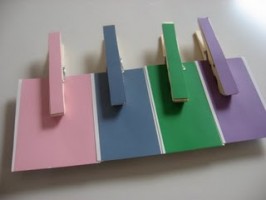
The clothespins become the turkey’s feathers. Use the feathers to do a variety of activities. For us, we were working on identifying colors. You could also do patterns
Since this was our first time doing the activity, we started with only two clothes pins and asked Charlie to select “red” or “blue.” Trying to grab the clothespins has the added bonus of being fine motor practice, but if he’s not able to squeeze properly, they still come off with a tug. If your child has trouble with fine motor, be sure to place the pins far apart to make it easier. 
When Charlie correctly identified the blue pin and threw it on the floor, we called it a day!
____________________________________________________________________________________________________________________________________________
Katy is a mom of one who loves art, mystery novels, and anything involving peanut butter–she blogs about raising her little miracle at Bird on the Street.