Posts Tagged ‘Early Childhood Education’

by Carrie Anne

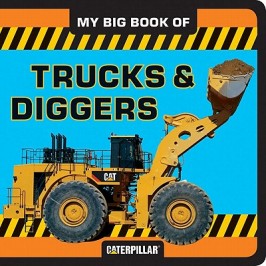
My Big Book of Trucks and Diggers
Raincoast Books
board book
Have you ever walked by construction and seen your child’s face fill with awe? Bulldozers. Backhoes. Graders. Construction vehicles are mezmorizing to kids, boys and girls. My Big Book of Trucks and Diggers is a sturdy board book with full colour photos of some of those big Caterpillar vehicles. Each spread focuses on one vehicle, offer it’s name in big bold letters with a full image along with a page that focuses on key aspects of the vehicle. You’ll find a close-up of the wheel or the boom ripper. Kids will love testing their knowledge on the vehicle names and the different vehicle parts. I liked that some of the vehicles were ones that I had never heard of (though perhaps construction junkie kids might know them already).
snuggle bunny
Raincoast Books
board book with puppet
Bedtime is the perfect time to snuggle together and enjoy a book. Let’s Get Ready for Bedtime! Snuggle Bunny follows a collection of stuffed animals as they get ready for bed. The story goes through a typical bedtime routine of tidying-up and brushing your teeth. Little ones will enjoy interacting with Snuggle Bunny, a hand puppet that is built into the middle of the book (the hole in the book enables Snuggle Bunny to appear on each page). The puppet doesn’t fit like a snug puppet so even dad’s hand would fit. I found the puppet not easy to control but I think just having the bunny there and moving around was enough to entrance my youngest. My little one even enjoyed retelling the story as she manipulated the bunny puppet.
Little Critter Numbers
Sterling Publishing
board book
I’m not a fan of character books like Dora or Clifford, but my kids love them and if these characters entice my kids into books, that can’t be a bad thing. Fans of Little Critter will enjoy counting with the Numbers board book. The book is a simple number concept book, offering both the numerical and written form of the numbers one to ten for number recognition. Each number is also represented by an animal for kids to count. Although there is no written story in the book, a story still exists in the form of following Little Critter through a visit to the zoo, taking pictures and counting the animals on his visit.
Rockin’ Babies
Sterling Publishing
board book
Not all parents are about fluffy white sheep and singing flowers. Some parents are about a little rock and roll and Rockin’ Babies lets them share their love in a fun cheeky way with their little ones. This cute illustrated board book takes typical baby moments, like having their photo taken by loving family or banging around on pots and pans, and puts a fun rockstar twist to it.
Disclosure : All books provided free to Carrie Anne  for review by publishers.
________________________________________________________________________________
Carrie Anne is a contributing writer on No Time For Flash Cards , she is a mom of 3 , and is the Managing Partner and Editor-in-Chief at EverythingMom.com.

spring sensory activities

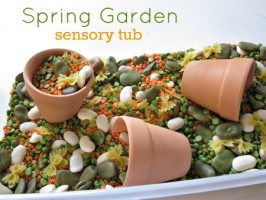
Sensory bins are such great teaching tools and for this one I wanted it not just to look like a spring garden but to feel like one too. So we stuck with earthy natural colors, all natural contents ( minus the tongs and pots) and talked about how we can ( and will) plant some of the beans from the bin and track it’s growth.  The big lima beans we used are big enough to be a chocking hazard for little ones so remember to only use contents that fit your children’s specific level of development.

  1. Gather your materials. You will need some dried split peas, large dried Lima beans, dried orange lentils, dried white beans, mini bow tie pasta and some small flower pots. You will also need a tub – this one was a dollar at Walmart.
  2. Start by pouring the dried beans and lentils into the tub.
  3. Next add a handful of butterflies ( the dry bow tie pasta).
  4. Add some mini flower pots and explore.
  5. My son was fascinated by the lima beans , they are not a staple on our dinner table.
  6. You can simply scoop and pour with the flower pots
  7. Or grab some tongs and sort and count.

Books About Gardening


The Tiny Seed by Eric Carle is a story about a tiny seed who unlike the other seeds from his flower makes it against all odds to continue the cycle of life. I really enjoy this book and love how it shows all the obstacles along the way for a simple little seed. Carle’s distinctive collage will keep your children marveling at the illustrations while learning about plants.

The Gardener

The Gardener by Sarah Stewart Is a really touching book that I would happily recommend for school age children. It’s a beautiful story about a little girl during the depression who is shipped to the city to work in her uncle’s bakery because both her parents are out of work. She is obviously nervous but knows that it’s something she has to do. She takes a little of the country with her in seed packets which she plants in the city while she learns about baking and becomes friends with her uncles employees. This is more a story about making the most of hard times, and would be a great way to talk about the great depression with your child. There are so many little things in the illustrations by David Small to talk about , from a picture of FDR to traveling by train and the general sense of sadness . In the end it’s a warm hearted book that I can’t wait to share with my son in a few years.


Zinnia’s Flower Garden by Monica Wellington is really useful not just about teaching about flowers and gardens, but also about patience and the annual cycle of a garden. Zinnia plants and waits, waters, enjoys her flowers, then they die, she collects the seeds and plans her garden for next year. I love that the main story is perfect for my almost 3 year old but there is much more for older children with longer attention spans. There is a little journal with notes about what’s happening with her garden, and various facts about plants as well. Like in so many of her books the author celebrates hard work and her characters take great pride in what they do. A fantastic message for readers, big and little. I also love the mix of illustration and photographs in this book especially, it gives the illustrations depth and a really interesting look.

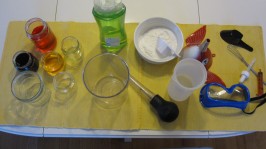
This is cool science !  There were no real instructions for this pretend play  just a buffet of fun things safe to mix in experiments.  My son got into this right away taking on the serious personality of a chemist as he dove into his imagination. This is so easy to do because all you really need is water and a few kitchen tools, everything else is just icing on the cake.

  1. Gather your materials. For our science lab we used a handful of glass jars -if you are really keen you can put graduated measurements up the sides, but remember kids imaginations don’ need every detail done for them.  You may want a few absorbent place mats, turkey baster, eye droppers, small measuring cups,  mini whisks, some shampoo or dish soap , some baking soda , water and food color.  Also eye protection and an apron or lab coat is a must!
  2. I added a few drops of food coloring in jars of water and set everything out – something I learned years ago is if everything is at arms reach fewer things spill . If I was doing this with multiple kids I’d ditch the chairs and have them stand at a low table.
  3. Start concocting! 
  4. The baking soda mixed with the shampoo made a nice ( not overly) fun fizzy foam, clearly the shampoo was acidic. This made me remember doing a science experiment in grade 4 with all sorts of things and mixing them with baking soda to see which was the most acidic. If you want you could incorporate that too.
  5. Keep going!  He had a blast.
  6. I got a tub ready to soak everything in after playing.
  7. We had so much fun I had to dump out his beaker and get him some new yellow water.
  8. Popped them all in the water – we let them soak and came back later to scrub. See this activity includes practical life and water sensory play too.

Part of learning to read is learning all about why we read. For pleasure, for directions, and for information. Most young children use the words story and book synonymously by introducing them to non fiction books you are opening their minds up to another use for books and print. So next time you are at the library checking out books if you don’t already know where the non fiction books are find out and grab a few . These are some of our favorites.

A Picture Book of Helen Keller (Picture Book Biography) by David  A. Adler tells the story of this great heroine in a simple way without loosing the magnificence of her life.  From her illness as a young toddler, to meeting her “miracle worker” Anne Sullivan and earning the first degree ever awarded to any deaf and blind person all of the amazing things that Helen Keller accomplished are covered. The author doesn’t sanctify Helen though , they talk openly about her tantrums as a child and her naughty behavior.  My son sat for this whole book, it opened up a bedtime talk about blindness to which we turned off the light and experienced a little ourselves. I am hoing reading this book will open more doors of empathy for my son, to recognize that we are all different with different abilities but are all capable of great things.

Imagine You’re a Knight! by Meg Clibbon is a fantastic book for children interested in what being a knight is all about. There are so many great details and answers given that I am eager to read more in tis series. My son loves this book and not just because it answers his many questions about knights but also because it’s the type of book that you can open and close as time permits , reading a little or a lot and still enjoying it. I like the humor and illustrations by Lucy Clibbon. It’s a great choice for 4 and older. 3 year olds might find it to be too much.

Delivering Your Mail by Ann Owen is a simple book about being a mail carrier. The text is to the point and perfect for toddlers and young preschoolers learning about mail carriers for the first time. It focuses on not just what the mail carriers do but how it impacts the reader, which is paramount for young children who see the world through their perspective only. Cute beginner book!

.

Little Shark by Anne Rockwell is another accessible non fiction book from one of our favorite authors. We follow a shark from birth until it’s full grown in this book filled with fascinating shark facts. I like that it reads like a story because it sucks the reader in instead of just spouting off cold facts about these cool and scary ( to me) animals. I loved that my son was rather shocked that sharks don’t stay with their moms or their many siblings, and are instead solitary. I loved how it explained a little bit about the food chain in the ocean and how we get oxygen from air but fish get it from the water. Add this one to your shelf!

Baby on the Way by William Sears MD, Martha Sears RN and Christie Watts Kelly  has been the very best baby book we’ve found. It explains much of pregnancy from nausea, to aching feet and even nesting. It also describes labor in a really kid friendly non intimidating way. I love that it explains that in mommy’s belly is a baby holder called a uterus. My son has been asking me how my uterus is since reading this daily for the past week. Explaining contractions, that others will likely be taking care of them for a little while and what mommy is doing when she is not with you is all really useful. It also goes on to explain what babies will do , like nursing, crying and what that funny crinkled thing is on it’s belly!  The book also offers many many resources for expectant parents.

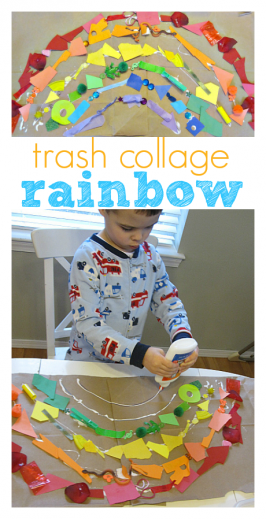
Trash And Recycling by Stephanie Turnball is a great book ! I learned more about garbage and the recycling process reading this to my son over lunch than I ever knew! He loved it and despite being a pretty sophisticated book for a 3 year old immediately asked to read it again as soon as I closed it. It explains the whole process from curbside pick up, land fills, incineration and recycling. The idea for today’s activity came from the sorting of  recyclable garbage from this book!

by Kim

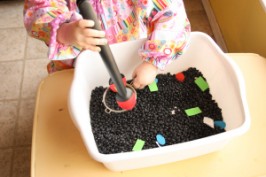
My daughter is learning her shapes and colors. She is doing fabulous, but I remember my son having trouble with certain shapes simply because we didn’t talk about them as much. Let’s face it diamonds, ovals, and octagons (other than stop signs) don’t really come up that often. So I came up with this sensory box as a fun way to practice these shapes.

You will need scissors, craft foam, cardboard, aluminum foil, and black beans.

I drew some shapes onto the craft foam and cardboard. Rectangles on green (for emeralds), octagons on red (for rubies), ovals on blue (for sapphires), and diamonds on the cardboard.

Cut the shapes out and wrap the diamond shapes with small pieces of foil.

Pour the black beans and shapes in the bowl. I chose black beans because I thought it would look more like coal. It really makes the colors stand out, too.

To make it a tad more authentic for mining, you can cut strips of construction paper and tape them together to fit around your child’s head. Then cut a 1 inch section off of a toilet paper roll and tape it to the headband. I thought we had yellow tissue paper (very cute for the headlamp, but we didn’t). He’s still cute, I think.

You can give your child tongs, sifter, strainer, colander, or measuring cups. Try anything to make it feel more like mining. It’s all about having fun.

Every time my daughter found a shape I would say “Wow, you found a blue oval. Great job!” or the corresponding shape and color. We had a blast mining. My son had to play along after he saw how much fun my daughter was having.

___________________________________________________________________________________________________________________________________________

Kim is a contributing writer for No Time For Flash Cards, a mom to a toddler, a preschooler, and a foster parent, too. She juggles her day by trying out fun activities and crafts with the kids. After all, she is just a big kid herself. See what she has been up to over at Mom Tried It.

PhotobucketPhotobucketPhotobucket

Find Us On Scholastic.com

This blog and more ways to support your child’s reading and learning life can be found on

Photobucket

Photobucket

Categories
Archives
Take Us With You

Photobucket

Grab Our Button


No Time For Flash Cards

This blog participates in the Amazon Affiliate Program in association with Amazon.

Feel free to use ideas at your home, school or anywhere else you teach and play.You may use one picture with a link to the original post if you are sharing/curating/ pinning this on a blog or site. Please do not repost/duplicate the whole tutorial or distribute printed out content without written permission from the original author.