Posts Tagged ‘Letter Recognition’

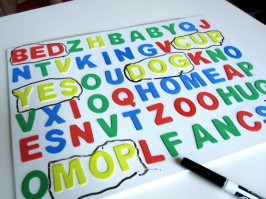
When children are learning to read playing games with their developing skills is a great way to practice while playing. This giant word search can be used so many ways. For my almost 5 year old I put in simple words he could recognize or easily sound out.  I also helped him by making all the words a consistent color and horizontal only. With younger children it can still be a fun game simply looking for specific colors or letters. With older ones you can make words multi colored, going every which way. The learning isn’t just in the searching either, using the dry erase marker to carefully circle the letters or words is fantastic writing practice and the foam letters are a sensory experience too.

  1. Gather your materials. You will need a sturdy backing like a inexpensive canvas or even some cardboard, contact paper ( which will make it wipe off) foam letter stickers ( two packs) and scissors. Also a dry erase marker to play with.
  2. Start by covering your canvas or card board with clear contact paper. This makes the surface friendly for dry erase . I found that a baby wipe worded the best to get the marker off after we played.
  3. Start making a column of letters.
  4. Decide on some words to pop in. Like I said in the preamble you can customize this to your child’s specific stage of learning.
  5. Add the words mixed with some random letters.
  6. Invite your child to play. I meant to make a list of the words I included but forgot and it turned out we didn’t need them. You may want one though.
  7. Oops he circled the o but it was no biggie because it’s dry erase!

I was fascinated by which words he knew by sight and which he sounded out. He loved this and I can see myself making a few more over the next few months for sure.

by Kim

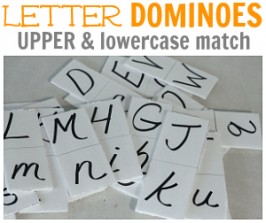
This is an activity that you will have to make for your children to play with. Don’t worry, it is very easy.

You will need a piece of foam board (I got mine from the dollar store), marker, scissors, and a pencil.

Draw lines for your domino pieces. I made mine with four rows going long ways and six columns going short ways. I used a piece of scrap I had for the missing two letters. I didn’t measure them out exactly, but this is where type A’s could really have fun.

Use your scissors, craft knife, or steak knife and cut out your pieces.

This is where I drew a line across the middle as a divider. I drew mine in pencil because I always mess up.

Write upper and lower case letters on each side. I drew mine in the same direction to make it easier for my children to look at the dominoes and decide which ones matched up. I didn’t want any upside down.

This is a very good time to pay attention to which letters you write next to each other on the same piece. You want your children to be able to match the letters throughout the alphabet. I just did them in order starting with an upper case Z on top and a lower case a on the bottom of the first. The second domino had an upper case A with a lower case b. And so on.

Now throw the dominoes on the floor and start playing an matching up!

You can alter these with site words and pictures, dots and numbers, or anything you would like some hands on learning and matching. The possibilities really are endless. What are you going to write on yours?

________________________________________________________________________________

Kim is a contributing writer for No Time For Flash Cards, a mom to a toddler, a preschooler, and a foster parent, too. She juggles her day by trying out fun activities and crafts with the kids. After all, she is just a big kid herself. See what she has been up to over at Mom Tried It.
by Kim

This idea actually started at Valentine’s Day. Our 3 year old (foster son) wanted to write his name on all of the cards for his class, like our 4 year old was doing. The problem is that he cannot write. We are working on it, but that time was not the right time to sit with two preschool aged boys as they wrote out 16 cards each (while keeping the 2 year old occupied and the baby entertained).

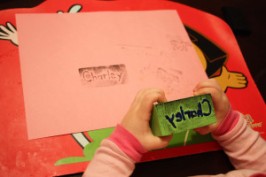
So I grabbed a block that had put away because of a choking hazard to the baby and made a stamp for the 3 year old to put his name on the cards. This became so popular that I had to make one for everyone. Here is how I did one for Charley (my 2 year old). Grab a block, any kind will do. You will also need a pencil and puffy paint.

Write your child’s name on the block, but remember to do it backwards.

This is what happens when you aren’t giving your craft your full attention. I honestly didn’t even notice how wrong it was until she went to stamp. Duh!

So now it should look like this.

Grab your ink pad and let your child start stamping their name away.

This stamp is great for those of you that gave your child a uncommon name or a unique spelling, like I did. I am never going to find anything that has “Charley” on it in the stores, especially geared for a girl. Now she has a stamp with her name and her spelling.

Obviously this is great for name recognition. It works well for phonics and letter recognition, too. And what kid doesn’t love to stamp?

___________________________________________________________________________

Kim is a contributing writer for No Time For Flash Cards, a mom to a toddler, a preschooler, and a foster parent, too. She juggles her day by trying out fun activities and crafts with the kids. After all, she is just a big kid herself. See what she has been up to over at Mom Tried It.

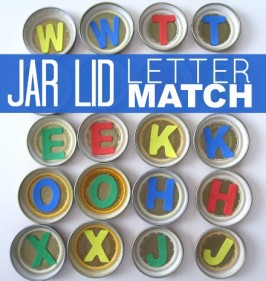
When my son started eating solids I made all his food… you can guess that is not the case with my daughter as I have this many baby food jar lids waiting to be made into something. I am just happy we made something useful and fun with them since they can’t be recycled like the jars can. This took me 5 minutes to make and $1 for the foam letter stickers. Frugal, Educational, Earth Friendly-ish ( foam letters are probably not eh?) and fun! Oh and super simple for the uncrafty or crazy busy .Oh and if your child is not ready for letters yet do colors, if they are way past letters try sight words. This idea can be adapted to any ability.

  1. Gather your materials. You will need some foam letter stickers and  many jar lids (or milk jug caps would work too). You may want to do the whole alphabet but I didn’t bother letters work in all different combinations and you don’t need the whole alphabet each time you do activities with letters. You may also want a wet cloth to wipe any lids that didn’t get washed as well as you’d hoped.
  2. Peel and stick letters into the insides of the lids.
  3. Add them for each lid.
  4. Play. For beginners play with the letters facing up saying only “Can you find…” giving hints using the color and what letters it’s next to.
  5. For more experienced kids play face down. My 4.5 year old needed more help than I thought he would, not naming the letters but understanding he needed to remember where letters were. He also had a hard time flipping the lids with Grandma’s gloves Batman gloves on.
  6. Yay a match!

Alphabet Books

Quilt Alphabetby Lesa Cline- Ransome is a really pretty alphabet book that makes me think of autumn afternoons, my husband’s grandma ( she quilts) and crave caramel apples even though it’s not a strictly autumn book. Every page is devoted to a letter and the short poem that accompanies it never tells readers exactly what the letter represents, instead readers must figure it out. It’s not too hard though because the stunning illustrations in bright warm colors wonderfully give it away for every letter. My kids both liked it although my son was hoping that S would be for Superman explaining that he grew up on a farm in Kansas.

A Was an Apple Pie by Eitienne Deslessert takes the classic nursery rhyme and adds odd dinosaurish aardvarky  creatures to it. I personally thought the creatures were odd to the point of distraction but my son gobbled up this book and loved the creatures . Yet another reason I don’t just read the books themselves , just cause I think something is odd doesn’t mean kids will. I really like the text to this because it’s simplicity is as brilliant as how it uses both all the upper and lowercase letters of the alphabet easily. Also because it’s such an old rhyme there are words we don’t often see in children’s contemporary literature and offers some new additions to your child’s vocabulary too.

“A” Was Once An Apple Pie by Edward Lear and Suse MacDonald is an adaptation of the classic Edward Lear poem that had both my children transfixed. The bold bright colors kept my daughter who is 10 months old wide eyed the whole time and the playful way Suse MacDonald adapted the text had my son listening from A-Z as well. It was incredibly fun to read allowed tongue tying me at times which resulted in us all giggling hysterically in a heap. A book that can do that is a must have in my opinion.

Guest Post by Jenae – I Can Teach My Child

Young children need plenty of opportunities recognizing and forming letters before they can become proficient at writing them.  Since the fine motor dexterity to form letters on paper sometimes doesn’t come until late in the preschool years, creativity is key!  When an activity blends multiple domains of early childhood development, this helps to engage your child even more. Here are just a few ideas for teaching letter recognition and letter formation in a fun and engaging way!

Window Streamer Letters
All you need for this activity is several small suction cup hooks and crepe paper streamers.
Place the suctions in the shape of the specific letter you are working on.  Then tear off small pieces of the crepe paper streamer and let your child place them on the suction cup hooks to form the letter.  The wonderful thing about this activity is that it blends language development (learning to recognize the letter) with fine motor development (the small muscles in the hands used to attach the streamer to the suction cup hooks).
Magic Wand Writing in the Air

Attach several pieces of ribbon or yarn to one end of a

dowel rod.  Let your little one create the letters in the air using the “magic wand.”
Playdough Snake Letters
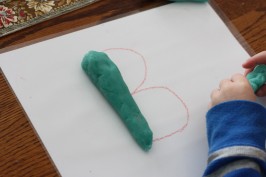
Write a large letter on a piece of paper.  Show your child how to roll the playdough in order to create a “snake.”  Then have him (or her) trace the shape of the letter using the playdough snake!

What fun ways do you and your child practice forming letters?

_____________________________________________________________________________________________________________________________________________

Jenae is a wife, mother of two boys’ ages 3 and 1, and former first-grade teacher. She loves spending time with her family and sharing fun and educational activities for young children on her blog I Can Teach My Child!

PhotobucketPhotobucketPhotobucket

Find Us On Scholastic.com

This blog and more ways to support your child’s reading and learning life can be found on

Photobucket

Photobucket

Categories
Archives
Take Us With You

Photobucket

Grab Our Button


No Time For Flash Cards

This blog participates in the Amazon Affiliate Program in association with Amazon.

Feel free to use ideas at your home, school or anywhere else you teach and play.You may use one picture with a link to the original post if you are sharing/curating/ pinning this on a blog or site. Please do not repost/duplicate the whole tutorial or distribute printed out content without written permission from the original author.