Posts Tagged ‘Numbers’

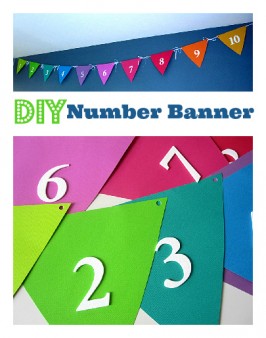
Providing an environment rich in print both letters and numbers is a great way to boost your children’s learning. This number bunting or flag banner was easy to make and cheap. As many of you know we have moved into a new house this week and one of the best parts of this house is that we have a dedicated playroom. Woo hoo! I get to decorate a classroom I mean a playroom with letters and numbers , toys and books. I will do a full reveal later (when I find my camera…) but wanted to share this number flag banner because it was super easy to make .
  1. Gather your materials. You will need some self adhesive address numbers (found at the hardware store), card stock, a hole punch, ribbon, pencil and scissors.
  2. Using a sheet of card stock create a template for your flag. I made ours large but you can do any size. I liked that mine wasn’t perfectly triangular but if perfect lines make you happy, grab a ruler too!
  3. Trace on every page . I used a pad of card stock with a rainbow of colors and simply made one flag per color but you could have fun with patterns too.
  4. Time to add the numbers. These are very lightweight which is what you’ll want so the flags aren’t too heavy for the ribbon to hold.
  5. Punch holes in the two upper corners of each page. I punched the holes in one then used it as a guide by laying it on top as a template when punching the holes in the next.
  6. Cut a piece of ribbon about 2 feet long and tie two flags together loosely.
  7. I did most of this while my daughter played at the table, but this project was great for doing a little here and there. I did most the tying the next day.
  8. Hang it up. This is our old master bedroom- the only place in our old house big enough for it.
  9. I carefully packed it into a ziplock – so if you are making one of these for a party you know it’s easy to transport without damaging.

Every day items make great math manipulatives . When my son’s preschool class did a similar lesson using nice counting bears I knew I wanted to do it at home but with stuff I already had in my art closet.  This activity was great because it gave my son a chance to do things he loves like estimate and count as well as things he resists doing like writing . All with things I had around the house!

  1. Gather your materials. You will need some jars or clear plastic containers, small items to pop in them , paper, a pencil, and a clip board. For some reason if I put paper on a clip board my son is way more excited to write than plain old paper.
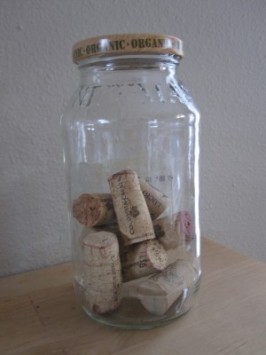
  2. Start by filling the jars with small objects.  I used corks, pom poms and plastic frog toys. Make sure there are enough to make it a little challenging, they shouldn’t be able to easily count the manipulatives when they are in the jar. 
  3. Write a simple chart to record the items are in each jar . We only recorded the estimates but you can also write the results. I want to encourage my son to write but without pushing.
  4. Time to estimate!
  5. Write it down.
  6. Open and count.
  7. Repeat with other jars . 
by Kim

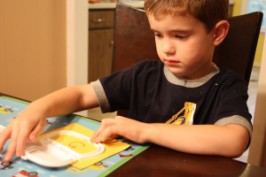
My son cannot stand traditional flash cards. I have to try to get creative. When I saw this idea forKnock-Knock Valentines on Silly Eagle Books, I knew this is exactly what I needed. You will need construction paper, glue, scissors, stickers, a marker, and the lid to travel size baby wipes.

Here is an example of the baby wipe lids I am referring to. I just pulled them right off of the package after I used all of them.

Draw lines on a sheet of construction paper dividing it into fourths. I had my son cut along the lines. Moms can take over this task if the little one isn’t quite ready for this yet.

Have your child put a designated number of stickers on the top of each wipe lid. For this post we did numbers 3 and 5 (but we have done 1-10).

Now put a bead of glue around the bottom of the wipe lid. A neat way to get your child involved with this step is to put some glue in a small bowl and let them apply it with a cotton swab. Glue the wipe lid to a piece of construction paper.

Once the glue dries, open the lid and write the number inside that matches the number of stickers on the lid.

Now your child has an interactive flash card! They can count the number of stickers on the lid and learn to recognize the number by opening their card.

This is great for sight words and introducing math equations for older kids. The possibilities are only limited by your imagination.

What would you put on yours?

____________________________________________________________________________________________________________________________________________

Kim is a contributing writer for No Time For Flash Cards, a mom to a toddler, a preschooler, and a foster parent, too. She juggles her day by trying out fun activities and crafts with the kids. After all, she is just a big kid herself. See what she has been up to over at Mom Tried It.

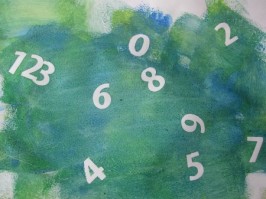
When you find something your child genuinely loves use it! My son adores painting with this roller sponge, he calls it his steam roller and pretends to be making a road on any painting we make with it.  When I suggested we make a magic number painting with it he all but leaped into the kitchen, which delighted me since he has not been as keen about art since the weather has been amazing, really who can blame the kid?

  1. Gather your materials. You will need a sheet of light colored paper, some vinyl number stickers, paint, plates and a sponge or roller sponge paint brush. Using a sponge is much easier when you want coverage. This activity doesn’t work well if the whole paper isn’t covered in paint.
  2. Start by placing the number sticker on the paper. Depending on your child’s ability you can simple pop them on , or challenge them to make numbers with them. For example say ” Can you make 23? Or 51? ” don’t push it though having fun with learning is the point not quizzing your kids.
  3. Pour paint onto the plates.
  4. Start painting.
  5. I called out the numbers at first for my son to cover with paint asking him if he could find 7 or 4  etc… but then he started to pretend that he was building a road and I sat back and listened to his pretend play.
  6. Let dry.
  7. Peel off.  As adults we know that the number will peel off and white will be beneath it but at least for my 3 year old it was a fun and awesome surprise – and he even thought it was magic that they were white!

Anno’s Counting Book Big Book by Mitsumasa Anno almost didn’t make it into my library bag. I am so glad it did. This is a wonderful book full of possibilities. There is no text , simple aerial illustrations of a field as it evolves one number at a time. The illustrations fill up quickly and it might take a while to see that you have to classify the pictures on each page to match it with the number on the page but once you do , each page is a lesson!
One White Wishing Stone by Doris K. Gayzagian is a beautiful book. Visually it reminds me of an impressionist painting, the soft beach colors used by illustrator Kristina Swarner are calming and pretty. This is more than just a counting book, there is a story of a little girl at the beach,what she finds and how she plans to use them when she takes them home. It’s so beautifully done that it almost makes me forget how much I hate finding sand in my car after a trip to the beach.

museum 123

Museum 123 by The Metropolitan Museum Of Art is another simple but beautiful counting book.  What I love about this book is that the number is not on the same page as the onbjects/images the child is being asked to count. Instead a simple question of how many is followed by a painting with the objects, and the next page has a large number. My son loved counting then flipping the page exclaiming ” I knew it , I said that number I was right!” My only complaint is that it only went to 10!

Related Posts with Thumbnails

PhotobucketPhotobucketPhotobucket

Find Us On Scholastic.com

This blog and more ways to support your child’s reading and learning life can be found on

Photobucket

Photobucket

I Blog Here Too

Photobucket

Alphabet Crafts eBook


Add to Cart

Categories
Archives


Grab Our Button

No Time For Flash Cards
This blog participates in the Amazon Affiliate Program in association with Amazon.

Feel free to use ideas at your home, school or anywhere else you teach and play.You may use one picture with a link to the original post if you are sharing/curating/ pinning this on a blog or site. Please do not repost/duplicate the whole tutorial or distribute printed out content without written permission from the original author.