Posts Tagged ‘Sensory Activities’

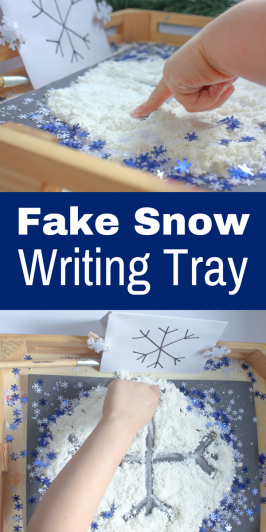
Not everyone gets snow. Not everyone that gets it likes to take their kids out in it. I came across a neat recipe for “snow” on Pinterest. {By the way, if you are not on Pinterest you should be! Allie’s stuff is all over the place around there, too.
} You can find the original post about it here on Flights of Whimsy. She calls it cloud dough, I call it snow.

I made half of the recommended amount she posted. So for my version you will need:
- 4 cups of flour
- 1/2 cup of baby oil
Yes, baby oil. Your room is going to fill with the sweetest little smell and take you back to milk breath (without the sleepless nights, of course).

You and your child can count out the scoops it takes to equal 4 cups. Go ahead and let them dump it in.

Now measure out 1/2 cup of baby oil. Your child can easily pour this right on the mountain of flour.

First my daughter stirred with a spatula. Then she mixed it with her hands because it will clump a little. It is very easy to break up and continue mixing, though.

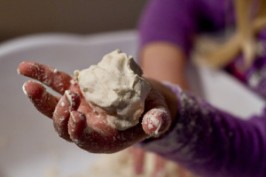
The texture is so nice. If your children have played with Moon Dough, it is very similar. It is light and fluffy. The scent is very relaxing. This is a fantastic sensory project. We mixed ours in a bowl, but moved it to a bin to play.

It molds easily. We used small bundt cake pans to make mounds and igloos. But the favorite was snowballs, which we threw into the mixing bowl to watch them shatter.
The dust from this does initially stick to your hands, but it brushes off remarkably easy.
Kim is a contributing writer for No Time For Flash Cards, a mom to a toddler, a preschooler, and a foster parent, too. She juggles her day by trying out fun activities and crafts with the kids. After all, she is just a big kid herself. See what she has been up to over at Mom Tried It.
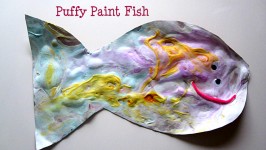
My daughter loves fish and I have been wanting to make another batch of homemade puffy paint so I decided to combine the two. We love this paint because it dries puffy even the big globs! I was planning on doing this just with my daughter but when my son heard we were making puffy paint he put away his Lego and ran to the play room. Making your own puffy paint is so simple and this time we mixed in some colored glue which added a lesson in color mixing into the fun. If you are making a big fish like we did make sure you have a place for it to dry away from little hands for a good 48 hours. Smaller puffy paint creations will dry faster.
- Gather your materials. You will need some craft paper ( paper grocery bags cut open work great), shaving cream ( plain jane variety), plain white glue, colored glue , a marker, tape, a bowl and some spoons. If you are adding a face you will also need some googly eyes and a pipe cleaner for the mouth.

- Start by taping down your paper and draw a big fish.

- Now spray some shaving cream into the bowl. The official recipe I like calls for 1/2 cup of glue and 1 1/2 cups of shaving cream. I just eye ball it now we do it so much. My son loves spraying it.

- Add glue.

- Stir.
- Pop it on the fish. She hated getting her hands dirty – I had an old towel and baby wipes handy.

- Add colored glue.
I was very impressed she didn’t try to eat it. 
- Explore. Both my kids opted for the spoons. They take after their dad, I was eager to mix it with my hands.

- We popped it in my master bath that is never used. It was a perfect place to be out of my daughter’s reach for the two days. But first we added two eyes and a pipe cleaner mouth.

- Let dry. Ours dried for 2 days then I cut it out.

Over at my other blog I have a fun fish themed idea for children just starting to recognize their colors. Check it out.
Books About Sea Animals
Secret Seahorse by Stella Blackstone is a fascinating and beautiful board book. The story follows a little seahorse that hides on each page as it makes it’s way along the ocean back to it’s family. The illustrations are felt, fabric, sequins and other fun and very beautiful hand stitched creations. I am never ready for the next page because the previous has so much to look and marvel at. Kids like finding the seahorse on each page too! My son and I re read this tonight to my daughter and she liked it but he was still loving it, which is pretty impressive for a board book. It’s just so pretty!
O Is for Orca: An Alphabet Book by Andrea Helman is a book about the nature of the North West packaged in an alphabet book. Each page is dedicated to one large photo and a animal, plant or other part of North West nature. My son was reluctant at first wanting to read a Star Wars chapter book but only a page or two in he was asking not to skip any of the text and we were discussing the information about the sea animals and he was eager to make a nest in our apple trees for the spotted owls who we read were endangered. Many of the letters represent sea animals like sea stars, urchins and of course orcas. There are a lot of facts in this book and if I were reading it to my toddler I’d skip the paragraphs and go through the alphabet and each photo only. That is what I love about books like this you can adapt them so easily to your audience.
Baby Beluga by Raffi is a classic children’s song cleverly illustrated into a beautiful book. I grew up on Raffi in Canada and am still shocked when moms don’t know who he is, if he is new to you go to your library and check out one of his cds. My son loves this book, there are so many sea creatures to point out, it’s great for toddlers. I must say that I am unable to read this without singing the song. It might be a good thing to read it before listening to the song .

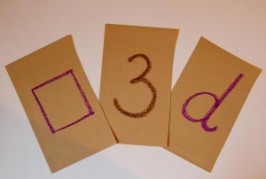
This was taught to me by a developmental therapist and I used this technique with one of my foster sons that had sensory issues. I never thought to do it for help with recognition for shapes, letters, and numbers. Duh! But I finally made the connection last month when I had the daunting task of coming up with activities for my children during a 6 hour car ride. You will see what I am talking about in a second.

The only things you will need for this activity are sandpaper, crayons (I used oil pastels since they are softer), and yarn. Yep, that’s it.

Draw any shape, letter, number, pretty much anything onto a piece of sandpaper.

This is especially helpful for me because our school system uses D’nealian handwriting techniques and you cannot find that as easily as traditional font activities.

Now give your child a piece of yarn (about 12 inches) and let them “trace” the shape or letter with the yarn.
*Please be careful, long strands of yarn can be dangerous for small children. This activity can easily use two pieces of yarn for a shape if needed. Only you know what your child is ready for.

Even though my son is past letter recognition, he had to join in because my daughter was having too much fun.

A neat benefit to this activity is that the sandpaper grips the yarn. So the yarn will stay in place as your child manipulates it along the paper. This is what makes it so awesome for travel, too. The yarn will stay where you put it. Now if your child waves the paper wildly declaring, “I did it!” the yarn will move a bit. As you can see.
Are you going to use shapes, letters, numbers, or do you have another idea? Please share.
_________________________________________________________________________
Kim is a contributing writer for No Time For Flash Cards, a mom to a toddler, a preschooler, and a foster parent, too. She juggles her day by trying out fun activities and crafts with the kids. After all, she is just a big kid herself. See what she has been up to over at Mom Tried It

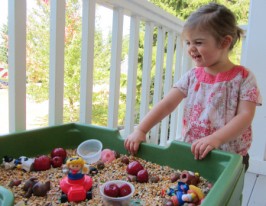
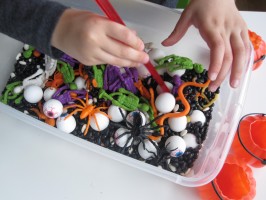
I noticed on Pinterest a comment on a pin of my Sensory Tub from Halloween 2010. The commentor noted that I use the same container ( usually yes) and just store the contents in ziplocks ( yes again I have close to 20 bags). That comment sparked this post. My son had been asking for a Halloween sensory tub since we bought the bouncy ball eyeballs a few weeks ago. My goal was to make one that both he and his baby sister ( 15 months) could use. This is what we did.
- Gather your materials. I grabbed my Halloween Sensory Tub contents from 2009 and 2010 – which included black beans, white beans, orange lentils for the fill. Then sticky skelletons, plastic spiders and other bugs, bouncy ball eyeballs , a few pumpkin containers , a scoop and some tongs. Do not feel like you need to have all of this! My main goal is to show that you can mix two old ones to make a new one.

- For the toddler version I started by putting in the dried beans and lentils. Then chose only the large plastic bugs and pumpkin containers.

- You may notice she is on a small rug. If you are doing this on the floor a carpeted floor works the best, the beans don’t skatter as far.

- Encourage them to keep the beans in , but please don’t scold. If spilling makes you angry just skip this activity all together. Gently show toddlers how to keep it in but until children have lots of experience with sensory tubs use only positive guidance. Anger will confuse them and halt any play and learning that was happening.

- Feel free to have them put beans back in though !

- Into the pumpkin!
- Now for older kids add the as my son calls it ” good stuff!” We did this when my daughter was daddy so it wouldn’t be unfair for her to see her brother playing but be told she can’t.

- I challenged him to pick up the balls with the tongs – it was tricky!

- He decided to pick out all the skelletons.

- Then he decided to create a skelleton world on the playroom floor, and the eye balls were bombs? Something like that. He asked if he could play it for his quiet time. Ummm yeah! I love how fun mama directed activities almost always lead to something for him to explore and lead himself.

When I stored this sensory tub I used 2 ziplocks, and picked out all the big kids stuff into one, the toddler safe in the other and store them next to eachother for fast fun for either kid.
** Please remember that it’s your job to know what is safe for your child and what your child is ready for . All activities require adult supervision. **
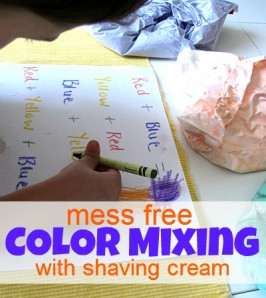
Doing projects with your kids is supposed to be fun for everyone, but when your kids are far apart in age it can be challenging. This project is perfect for different ages! Since having my daughter last year one of the most common questions I get is ” How do you craft with both kids?” Some days I do just a baby project, some days just a big kid one but there are times that we can all work together despite the almost 4 year age gap. This color mixing activity was perfect . They each had their parts and we had a blast being color scientists although if you ask my son his sister was his lab assistant not a full scientist, that is only for big kids.
- Gather your materials. You will need some good quality zip lock bags, shaving cream, some paper, crayons or markers, and food coloring.

- Start by making a simple chart showing the colors to mix , leaving the result blank. Make sure you have the correct color of marker or crayon available for the result. We made 4 colors, adjust the number of colors based on the attention span of your “scientists”.

- Add shaving cream to the zip lock. My son helped me with this step- he was so excited. I love when simple things make his day!

- Add the food coloring. We added 2 of each color but then increased it to 5. Look now they are counting too , I love when projects span many subject areas.

- Zip it up , making sure to squeeze out some air so when your “lab assistant” squishes it that the bag doesn’t pop.

- Squish! Until the colors are all mixed.
- She loved squishing, just watch they do not put it in their mouth. Whenever you are working with toddlers or infants you must always be within arms reach. Label the colors, use descriptive words while they explore.

- Come back and record the results by finding the correct color and completing the chart.

- Talk about the results. Ask if any colors were surprising , which color do they like the best and why?

Crafting, teaching or just generally parenting is different with multiple abilities but with a little effort you can find activities that can be done at the same time for every child in your care. We had a blast and another real benefit of a cooperative project like this is that your kids are working together something that isn’t always so easy to achieve.