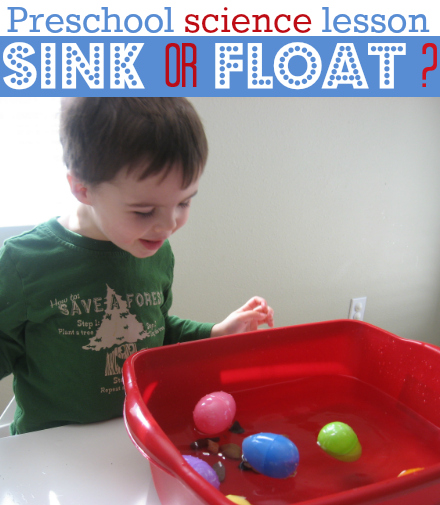
 I have done many times with my son but now that he is 3 and has starting asking more complex questions, able to use information to make solid predictions it was way more fun! Using Easter eggs doesn’t simply add novelty, it add another dimension of learning, as we added more items to the eggs to see if the amount would change the result.
- Gather your materials. You will need a plastic tub, some plastic Easter egg, tape to cover the holes they have, and a range of items to pack inside. We chose a lego, some feathers, coins, rocks and dry pasta. You will also need some crayons in the same colors as the eggs, a marker and paper to make a prediction and results chart.
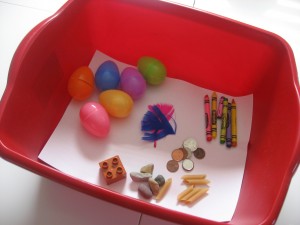
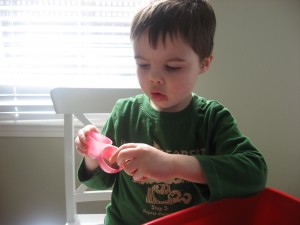
- Start by filling your eggs with the contents. Don’t forget to add tape to the holes so water doesn’t get in.
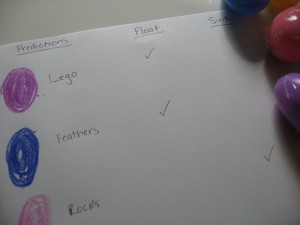
- Make your easy peasy chart. Draw the egg, write what’s in them and have your child decide if they think it will sink or float. Talk about how when they decide they are making a prediction. Ask them why they think each will sink or float.
- Do your experiment. Pop the eggs in the water and discover if it sinks or floats.
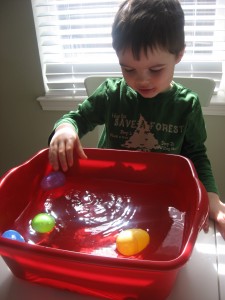
- Was the result what you expected? All of ours floated so we opened up the one with rocks in it added more and then it sunk. This was the best part of the whole lesson because my son figured out why it sunk the 2nd time but not the first! Since doing this last week we have “tested” many other things from a match box car ( it sunk) to a sock!
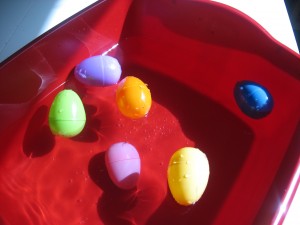
- We also opened some of the eggs up to see what would happen, and blew air on them too. Some moved some didn’t can you guess why?;) Love that one experiment leads straight to another!
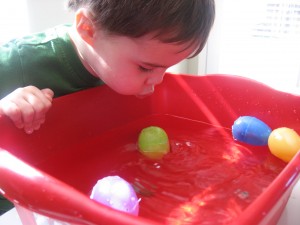
What I love about teaching through experiments is that kids grasp things on their own, the true pleasure of making a discovery is obvious on their faces and it makes a mark. They remember and understand this experience much better than if we simply told them why things sink and float.
Ashleigh says
Thanks for sharing! I’m adding this to the list of April activities for my daughter!
Tanya M. says
Awesomely creative and inventive! I haven’t seen this idea with eggs yet and will definitely be doing this. Thanks for the great idea, Allie! You rock!
Min says
It’s a nice twist to the typical sink and float activity. We’re going to try this!
.-= Min´s last blog ..Not Just a Box =-.
Natalie says
We did the same “sink and float” experiment last year – it was a lot of fun. But I think it will be even more fun this year when she is 3 and understands better how things work. I love the last picture – he definitely looks fully immersed in this experiment.
.-= Natalie´s last blog ..Social History – Passover =-.
Jen says
Never too old for sink or float! My girls love finding things around the house and testing them. They also love to test magnitism with items around the house. We charted our results, too.
Jen
.-= Jen´s last blog ..Fairies Galore! =-.
LindsayDianne says
This is a great idea and I’ve never seen it done.
Thanks!! Something for us to do on this rainy afternoon
Staci says
This was fun! We just did it at the kitchen sink and gathered up materials around the house. Sometimes I was even second guessing whether it would sink or float. Ha! My daughter has now turned one of the containers into a “boat” and is still going strong at the sink.
.-= Staci´s last blog ..Ziploc MONEY MAKER at Kroger =-.
Julie says
We play “sink or float” in the tub on the days that DS doesn’t want to take a bath. Works every time!
Stacy says
Thanks for the fun twist on a classic experiment. I linked back to you.
http://givinguponacleanhouse.blogspot.com/2010/03/sink-or-float-experiment.html
Kasey @ All Things Mamma says
GREAT project to do with my daycare kids this week while on Spring Break. thanks!
.-= Kasey @ All Things Mamma´s last blog ..It’s Time =-.
Anastasia @Healthy Mama Info says
What a great idea! love it.