by Katy
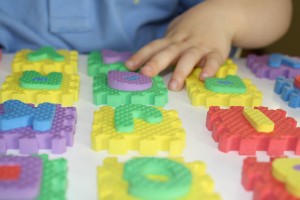
One of the best ways to help a child learn is to have them use more than one sense at the same time. I’m guessing that’s one of the reasons why Allie is so passionate about doing crafts with kids–all kinds of senses are engaged, which makes learning easier and also fun. It can be hard, though, when your child has issues that prevent them from participating in crafts. Today I’m sharing three ways to do the alphabet with kids with limited motor skills although I think they would be fun for all kids.
Alphabet Stamps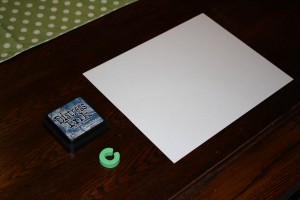
I bought a pack of foam letters at Walmart for one dollar and turned them into two activities. First, I used them as stamps and let Charlie stamp on a sheet of paper. As we’re stamping out the letter, it’s good to name it and tell your child the sound it makes.
I then took the foam pieces and glued them to a piece of cardboard to make an alphabet puzzle. Since Charlie’s aim is rough, I put all the letters in and then let him pull them out. I let him decided which letter looked good and then I would again, name the letter he was touching and say it’s sound aloud.
Big Letters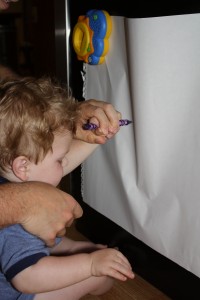
This activity is also great for improving fine motor skills–I don’t completely understand the relationship between big motions and improving fine motor, but multiple therapists have told me this, so I’m going to believe them. Take a sheet of paper and put it up on your refrigerator. Give your child a crayon or marker and help them make BIG letters on the paper. I found that Charlie was able to make some c-like motions, which is pretty impressive for him. Children with poor neck control often do better when activities are propped up in front of them because it requires less head control.
Sugar Writing
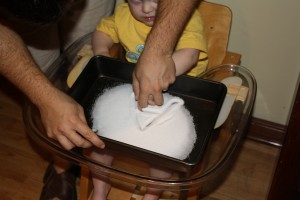
You can also use sand, but sugar is easier for me to find. Pour about half a cup of sugar into a baking pan. If you can find one with a dark finish, then that will work great. Help your child form letters in the sugar with their fingers. This was probably Charlie’s favorite activity of the bunch–probably because it was one of the few that he was allowed to taste!
As always, don’t be discouraged if you try and activity and your child doesn’t like it. All children are picky and special needs kids can often be intimidated by new experiences. Experiment with different ideas, try activities multiple times, and remember that not every activity is going to be a hit.
_________________________________________________________________________________________________________________________________
Katy is a mom of one who loves art, mystery novels, and anything involving peanut butter”“she blogs about raising her little miracle at Bird on the Street.

Kiasa says
This is great. My 3.5 yr old is a strong kinesthetic learner. We trace letters with her finger and do sign language while she looks at the letter and it really helps. I’m excited to try these with her too.
Cathy @ NurtureStore says
Great ideas Katy. We always try to come at a new learning experience from lots of different angles and adding a sensory element is really beneficial. We’ve been making a touchy-feely alphabet recently, similar to Allie’s alphabet crafts but with a ‘touch’ element to each letter. We’re doing ‘s for sand’ today.
.-= Cathy @ NurtureStore´s last blog ..One potato, two potato =-.
Teri says
Another (tasty) alternative to salt, sand, or sugar is jello! That engages sight, taste, touch AND smell! 🙂
.-= Teri´s last blog ..Super Rite-Aid Shopping! =-.
The activity Mom says
Great post! Here are some other activities that we did with those small abc foam squares:
http://activitymom.blogspot.com/2010/06/small-abc-foam-tiles.html
.-= The activity Mom´s last blog ..1000 Readers Celebration Giveaway #5 =-.
Lizzie Ater says
Another great sensory activity is using shaving cream to write letters in! It also smells nice!
Laura says
Shaving cream is great! If a child has sensory issues I put the shaving cream in a ziplock bag and tape it up. that way they can still trace letters but there is no mess!
Allison McDonald says
Great tip!
Steph says
Hi! Great ideas! The link between large movements and fine motor is due to the way children develop. Babies start to develop head down and from inside to outside. So head control happens before pushing up on arms and pushing up on arms has to come before crawling etc. This also means that the gross motor skills must develop to provide a good base for fine motor skills. A child must have shoulder and arm strength before hand strength will develop. Fine motor skills also refer to motor planning which is organizing the gross motor movements. For example, the child must be able to physically move the puzzle pieces before he can plan how to organize and then go ahead and move them how he wants them. I hope this makes sense! Ask your therapists about it and they will give you more detail! 🙂