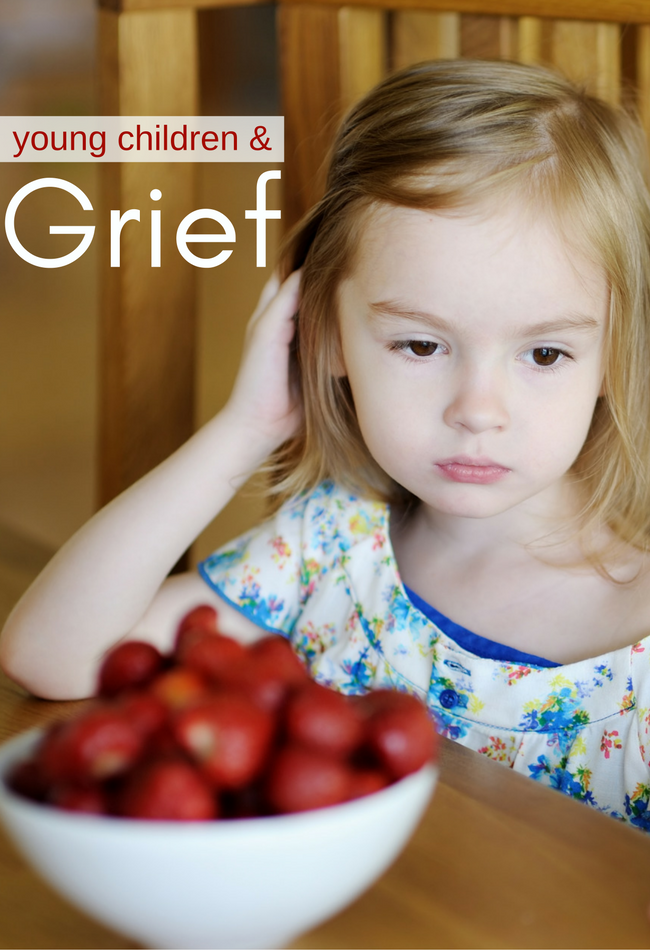
As part of my graduate studies in early childhood development I completed a course on death and dying. It was not an easy course; it was challenging because death is uncomfortable and thinking about children dying even more so. That said it was also very empowering because I got to explore more deeply the role teachers can take with grieving children. The themes that emerged week after week in the research was that there is no one model for the grieving child, especially the very young, like all areas of child development, the stages of grief when it comes to children are very individual.
Before we look at how preschool teachers can support their students and student’s families when they are grieving let’s look at how young children see death.
How do preschool-aged children see death?
Preschool age children ( 2-5) don’t usually understand the permanency of death. They may see it as reversible and temporary, as a separation but one that will not last forever. Children at this age are firmly in Piaget’s pre-operational stage which is marked by an egocentric view of the world ( it revolves around them) and ample magical thinking. They may think that if they wish hard enough, the deceased can come back. Conversely, they may think that their wish that their loved one would go away forever was responsible for their death. Preschool-aged children do not fully grasp that death is biological and their wishes can no more bring someone back to life than it could kill someone.
It should be made clear that they understand separation, even from a much younger age, but the concept of death being a permanent separation is not understood. This can be very frustrating and be upsetting for young children because their experience thus far with separation resulted in reuniting with the loved one. They simply do not understand why their deceased loved one is not returning.
How do young children process grief?
They may be playful and boisterous as a way to compensate for the expressions of grief the rest of the family is displaying, they may be angry and aggressive, and they may withdraw. Young children may react to the instability that a family death causes in their routine and the emotions their caregivers are expressing more than their own emotions caused by the death. Do not be surprised by intense separation anxiety even in children who have always separated easily, reassure parents that sleep and toilet training regression is normative as well. Many children who experience loss when they are very young experience delayed grief. As children’s concept of death progresses their understanding of their loss deepens, and they experience it all over again at a new level.

Why does this matter?
It is important to understand how preschool age children conceptualize death because it allows us as teachers to better serve them and their needs. Here are ways teachers can use this information to help grieving students;
- Provide a safe, loving, and predictable environment for the child.
- Be there to listen to the child in early childhood this is often done through play instead of words. Do not shame a child for exploring the idea of death, allow them to explore and worth through their feelings through play.
- Answer questions simply but honestly. Assure the child that their needs will be met.
- Do not use euphemisms like passed away, gone to be with Jesus, with the angels now, etc…
- Never force a child to speak about the death, you are a teacher, not a therapist. Instead, provide a loving classroom where grieving children can play and feel comfortable if they wish to discuss and express their grief.
- Expect inconsistent behavior from a grieving student but offer routine and firm boundaries at school. Remember, the student’s routine at home has been disrupted offer a predictable routine at school.
- Expect regression in areas such as sleep ( including nap time at school and home), eating, and toilet training. Never punish a child for this.
- Support the grieving family by being flexible with all extra commitments ( such as bringing in snack, volunteering as a readers) families may have signed up for and can no longer do.
Research supports incorporating books about death into classroom activities and curriculum. In my preschool classroom, we often discuss death as we learn about emotions, families, and pets. These aren’t targetted lessons but teachable moments as topics come up. When we frankly but sensitively discuss death rather than shying away from it and making it taboo, we help our students better understand that death is part of life and, most importantly, that it’s okay to ask questions about it.
When there is a death in your classroom community.
As a teacher with a small class, in a small community, and a strong relationship with my students’ parents, if a student’s sibling or parent died, I would choose an age-appropriate book to share as well as contact the other parents. Please remember when you select a book, if you go that route, to choose one as closely related to the death as possible. If a child’s parent died, do not read about a pet dog dying. A friend who lost her husband shared with me how devastated her child was when this happened. It’s best to discuss plans with the family or family representative so that you do not add to their grief.
If you teach in a public school, your district may have policies, and you must discuss them with your admin team. As a teacher, you must look at the child and their need and advocate for them while respecting the grieving family’s wishes. It is never easy when a student is dealing with a death in the family, but if you follow the eight tips above, it will be easier to support a grieving student.
I wanted to add this video—like many others born in the 1970s, this was my first real experience with death. Big Bird captures how preschoolers react, and the adults are excellent models for how we can lovingly support children as they grieve. I especially like how the adults reassure Big Bird that they will make his birdseed milkshakes now that Mr. Hooper won’t be able to. Focusing on Big Bird’s needs and how they will still be met. This is the most important thing to focus on as we support grieving students.
I
What tips do you feel I missed? Do you disagree with any of the tips listed? Tell me about it in comments.
Not a teacher?
Here is a great resource for parents looking to explain death to their children.



Leave a Comment