Updated January 2025. Before your students can connect specific letters in words to sounds ( orthographic mapping), they need to be able to differentiate between sounds. Young children need time to play with and manipulate letter sounds long before they start learning which written letter makes that sound. Young children love to sort and classify but did you know it’s actually a very powerful teaching strategy too? Classifying things into yes and no examples is a powerful way to learn. This strategy is also a great way to differentiate between letter sounds using these letter sound sorting cards. These cards will help you create all kinds of activities that are tailored to your students, their abilities, and their learning.
The majority of this set of letter sound sorting cards, I focused on what we would be using in an early childhood classroom; the consonant sounds and the short vowel sounds.
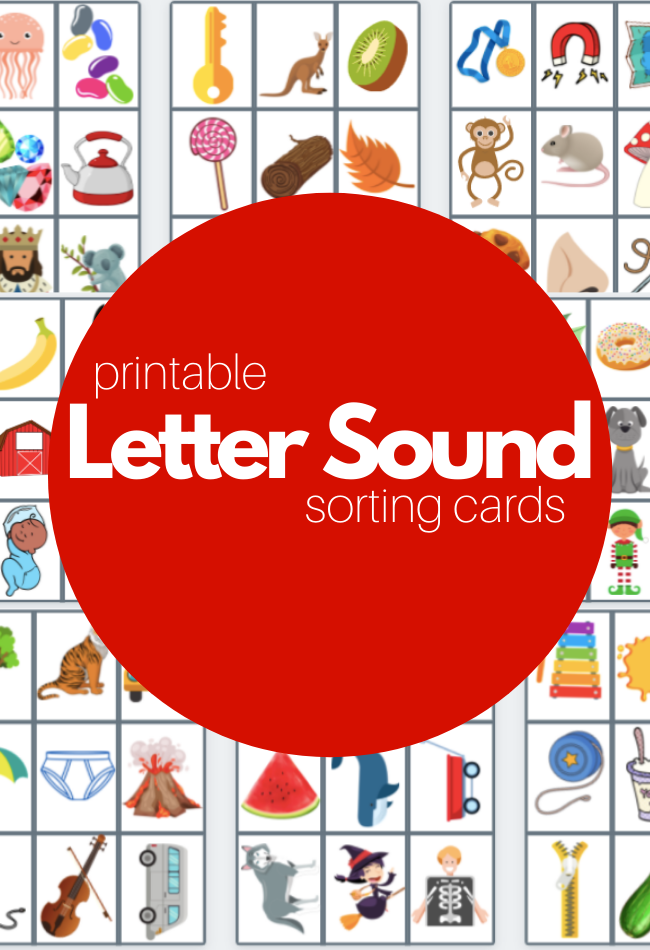
Updated for 2025
As we learn more about how children learn letter sounds, we as teachers have refined our practices, and I refined and adjusted mine long ago but haven’t adjusted this product.

What’s different about this version?
I have added more images in the first section of things that start with the same specific phoneme ( singular letter sound) without blends, nasalization, or r-controlled vowel images. In the original version, all the vowel sounds are short, and I have now added long ones, too. When introducing sounds, we should stick to the short vowel sounds and the typical hard consonant ones ( goat for g, not giraffe, for example). However, many of you wrote that you are using these cards past the beginner stage, so I have now included more examples of these phonemes to match.
The X images are not for the initial sound, but the final sound. Research supports that for X we are best using the final sound i words like box, fox, six, and sax. So that has been adjusted. have left blends in, but moved them to the section section along with the long vowel and soft c and g sound cards. use these as well as the soft consonant and long vowel sounds as needed, not for the initial introduction. I have opted NOT to include digraphs as they should be introduced well after children start formal school.
Remember, sounds are regional, so I’ve given you options!
Please note that our accents affect how we pronounce words – so you may be saying “ I can’t use avocado for the short sound, that’s spelled with an a but, the phoneme is /o/.” True in many parts of the US, but growing up in Canada I said it with a short a to start. When I taught in St.Louis, egg was pronounced with a long a sound, but in Washington state it’s a clear short e sound, so it’s good to use.
You are a pro, use your discretion, about what cards are best for YOUR students, both based on accent, and where they are in their learning journey.
Here are a few ways to use Letter Sound Sorting Cards
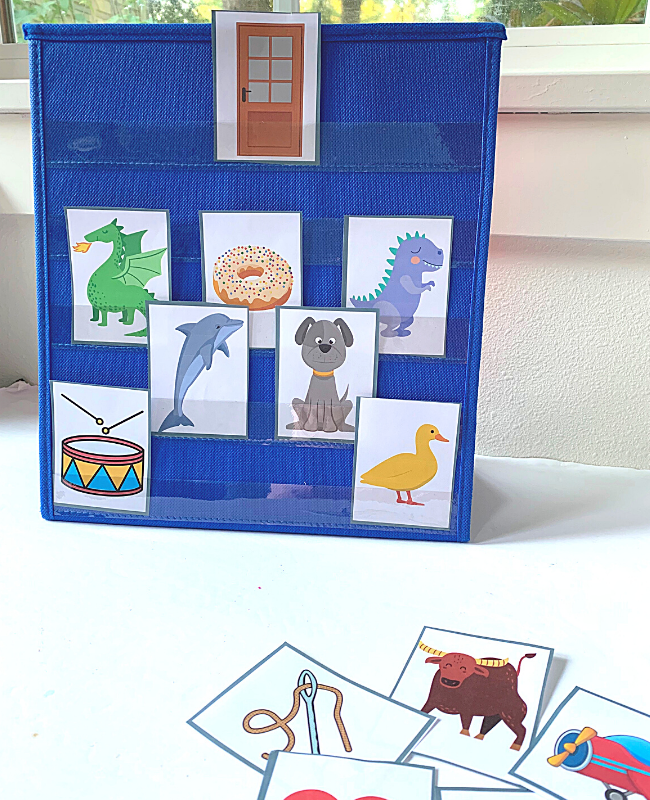
- Same/ Different ( Group Activity)Grab your pocket chart and a bunch of the cards. Ensure you have all the cards for one letter sound and a random assortment ( no duplicates) of others. We want the children to be listening for one specific sound. The goal here is to learn what is and what isn’t that sound. This can be done in a whole or small group setting.
Give each student a card. In a small group, you can give students more than one card.Place one card of the sound we are looking for in the pocket chart.
Announce the item in the pocket chart “Baby” Invite the children to stand up and announce what they have. Does that picture make the same sound as the picture in the pocket chart? There is no need to stretch out words or specific sounds. Say the words normally and let the children hear them as they would as they are reading or speaking.
All the pictures that don’t fit this sound place in a pile on the floor.
Read the pictures together, making a lovely alliteration baby, bottle, books, barn, bat, bee, banana.
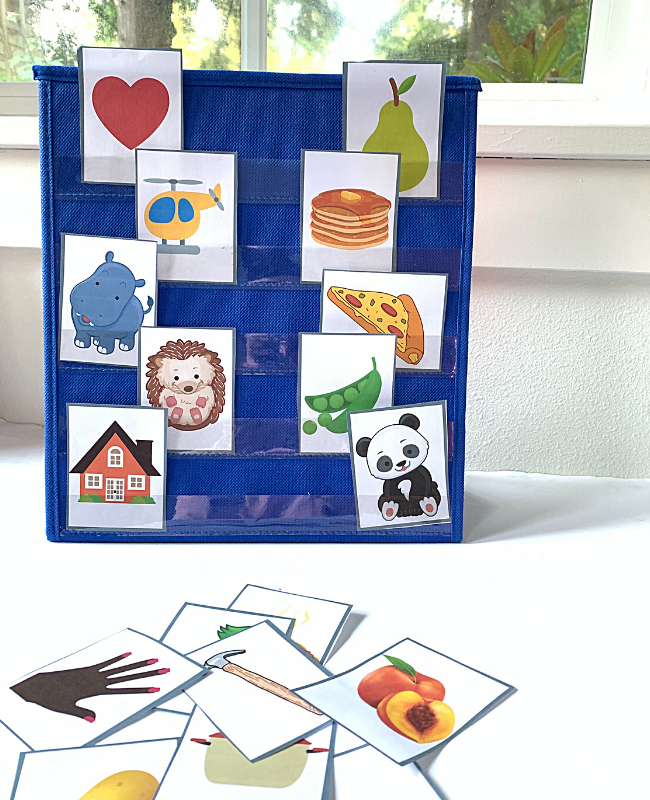
- This and That ( Center or free choice activity)This sorting activity is simple. Separate two sets of letter sounds. Pop one picture on one side of the pocket chart and the other letter sound sorting card on the other. Leave a big pile of cards making those two sounds, and let your student separate them into two groups.
I love this activity for free choice because it lets me observe and see which of my students are interested and capable of this and if there are any that aren’t or need some help.
Sound to Letter Connection
I know I said that we weren’t going to focus on connecting printed letters to the sounds, but I wanted to give you the next step if you need it. In all my teaching experience, I have always had some children ready for the next steps long before their peers. Teaching in a developmentally appropriate way means being prepared to teach the child in front of you, whether making something more simple or making it more challenging. Here are some fun ideas to use these letter sound sorting cards.
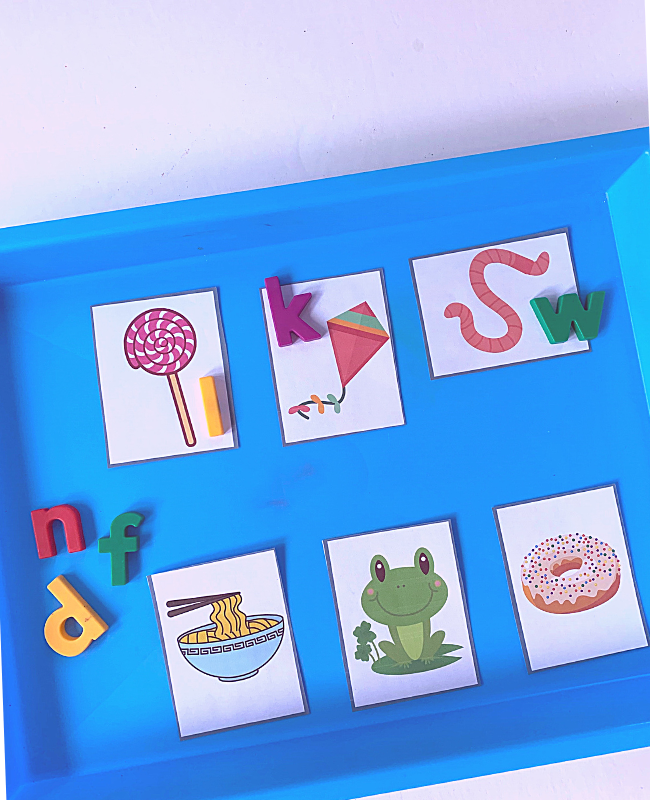
- Picture Letter Hunt
Hide cards around your classroom, using only one card per letter sound. Using letter magnets, paper, or sentence strips, write out the letter sounds you are hunting for. After your students have found one card each, it’s time to match them up. “Who has something that begins with A?” if your students need help, give examples including but not only the picture you know they have ” Apple, avocado, and ant are some examples. Does anyone have one of those?”
Note that I don’t do this in alphabetical order. That’s by design. Letters aren’t used alphabetically, so we always want to teach the way we use something.
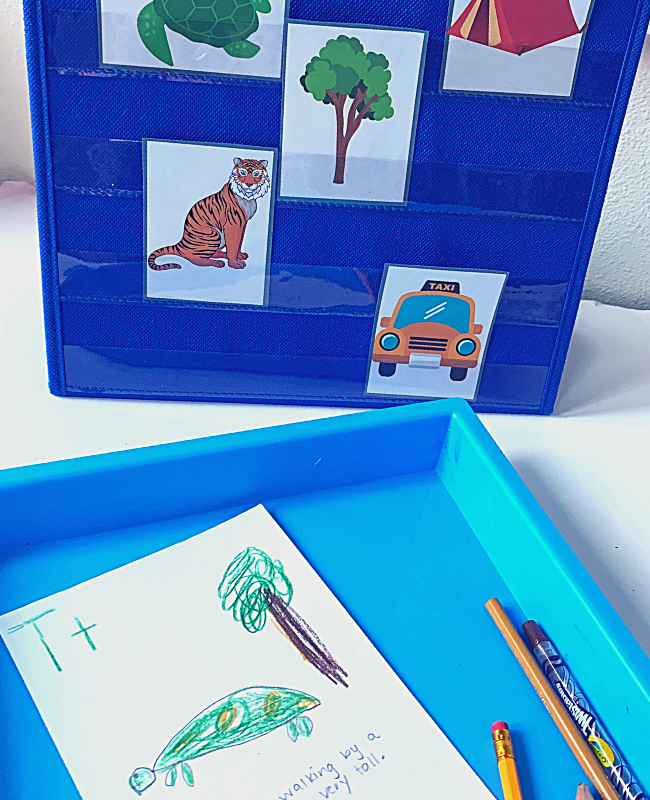
- Alphabet Book
Invite your students to create their own alphabet book. This isn’t a one-and-done activity. This is a long-term one. Every few days, at free choice or another designated time, offer children the chance to make a page for their alphabet book. Use the letter sound cards as examples for items for each letter, of course allowing students the opportunity also to draw something else that they know with that letter. When the student is done with their drawing, have them dictate what it is and write it on the bottom of their picture. If your student can write this themselves, by all means, encourage them to do so.
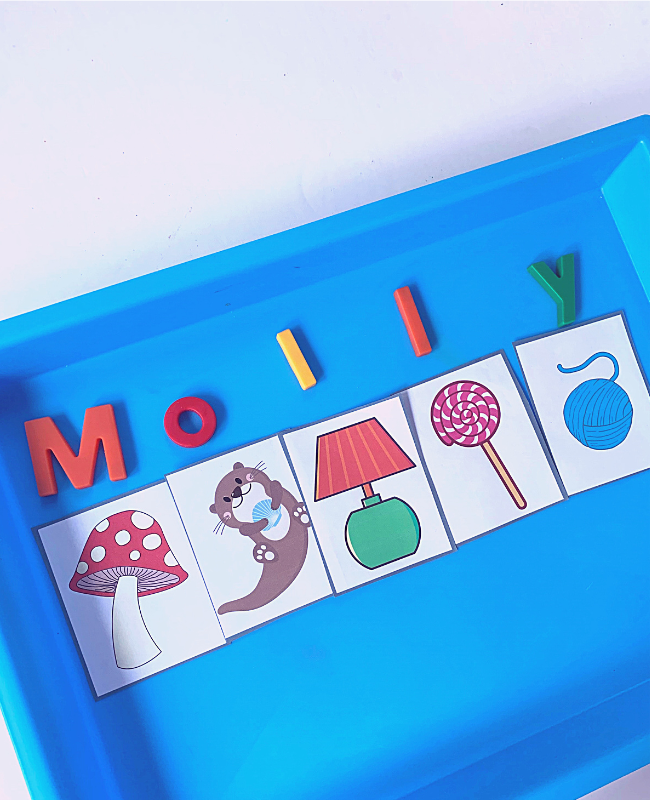
- Spell your name in pictures – yep, just as it sounds.
Have letter cards available on a table along with sentence strips with your students’ names on them, or use letter magnets like I did. Invite them to make their names with pictures! This isn’t an easy activity, but for students who are looking for a challenge. This is best done in a small group or teacher table where you can quickly pivot if the challenge is too much to avoid frustration.
Get all 108 printable letter sound sorting cards ( that’s 18 pages) here for just $3.99

Gaby says
Hi! I think this activity can work really nice in Zoom! I wanted to ask if by any chance these cards have the option of black and white so the children can colour them? I think it would add more if they could colour them the way they wanted (also to add motor skills invitation if theyd like to). Thank you.
Allison McDonald says
Let me do a preview of them in black and white, I bet you could just print on your printer as black and white.
Carrie says
Where can you find stickers like these?
Allison McDonald says
These aren’t stickers it’s a printable that you can buy.