Archive for September 2009
Flying Ghosts

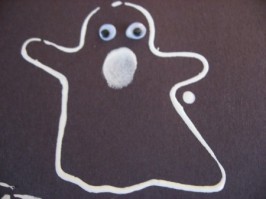
I wanted to start the slew of Halloween crafts with something easy and fun for a wide range of ages. I always try to have crafts that can be changed ever so slightly to fit all ages in the family. My son loved this ! For older children I would have used glow in the dark paint and have them fill the ghost body in carefully with white crayon before gluing on the eyes. Then the craft would have been cool in the dark as well!
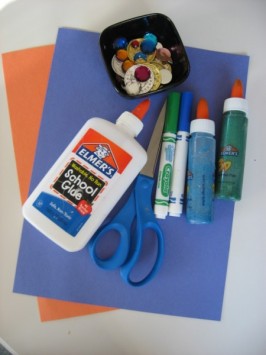
- Gather your materials. You will need black paper, white paint, a dish, a ghost cookie cutter, glue and googly eyes. I had the orange paper to make a back to frame it but the ghosts ended up too close to the edge and I didn’t want to cut them.

- Pour the paint in the dish and dip your cookie cutter in.

- Print. Don’t worry if some are wiggly- I think they make it look like the ghosts are flying.


- Add glue for the eyes

- Add the eyes.

- Dip your child’s finger ( or your finger because and I quote” No mama you do it, I share my art project with you, your turn!” ) in the paint.

- Press on to make the ghosts mouths.

- Let dry.
Halloween Books!
I am looking for some tried and true Halloween books. Of all the schools I taught at only the last allowed any holiday reading and my favorites have already been featured. I want to hear about your children’s favorites. Please send in the title , a very short description/review and your blog url and I will fit them into the Halloween crafts that will be coming up in the next month.
Send them in : allie@notimeforflashcards.com
In case you missed them here are my favorite Halloween Books!
Spider s

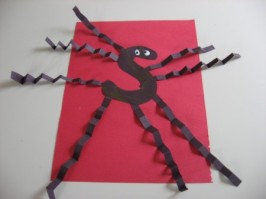
Our backyard is chock a block packed with spiders! I knew we had to do something with spiders. Also Halloween isn’t far away so today’s letter of the week can be done for a Halloween craft by changing up the red paper for orange or simply a spider. We chose to keep is simple since my son had preschool today and I didn’t want to overload him. But if your child is keen you could use glitter glue to make a spider web on the back page for extra bling!
- Gather your materials. You will need 2 pieces of construction paper, scissors, crayons, glue and or a glue stick, and googly eyes.

- Start by writing a chunky lowercase s on the lower half of the black paper. Cut off the top.

- Have your child color it- my goal here was for him to use silver and gold ( they really show up on black) but he chose yellow and green which was a ok because he was happy.

- While they color fan fold some of the extra black paper. If your child is able to do this have them, it’s awesome fine motor work!

- Cut into 8 legs.

- When your child is done beautifying their spider, cut it out.
- Add glue to the back with the glue stick.

- Add the 8 legs.

- Slam the S down on the red paper.

- Add glue for the eyes – yes he really made both the globs himself, he was so proud of himself.

- Add the googly eyes and let dry ( if the glue is as plentiful as ours it will take hours).

Halloween Book Preview
” Inside a House That Is Haunted” by Alyssa Satin Capucilli was the hands down favorite Halloween book for my 3 year old class in 2005. I must have read this 200 times and even after Christmas had come and gone it was still requested all the time. The story is a rebus read along, so it is repetitive and it builds upon itself. This is great for children who are eager to “read along” before they are able to read words. The repetitiveness allows them to anticipate what is next and feel included. Very cute even after reading it hundreds of times.

“CinderHazel : The Cinderella of Halloween “ by Deborah Nourse Lattimore is a spin on the classical favorite fairytale Cinderella . The book was too long for my son, which didn’t surprise me at all. He said the witch was scary and walked away. I don’t think he meant it I just don’t think he was into it. The story is about Hazel who is a dirt loving witch who doesn’t mind dirty fireplaces at all, in fact she loves them . When she is told she can’t go to the ball it’s not the love of a prince that motivates her to go but rather the 15 dirty fireplaces at the castle and the very fact that her stepmother told her no. As it would turn out the prince is pretty filthy himself and they are a match made in heaven. Similar to it’s inspiration but clever in it’s twists , I especially love that she rides a magic vacuum cleaner to the ball , no pumpkin turning into a coach in this book!
” 10 Trick – or Treaters“ by Janet Schulman was the book I bought to try and eclipse ” Inside a House That Is Haunted” and while my class loved this one two my plan didn’t quite work out. This book has the most adorable pictures and in every page there is an owl hidden somewhere, which is a great trick to keep reluctant readers involved. The story counts down from 10 to no trick or treaters with fun rhyming text and a fun array of trick or treaters in cute costumes.
** Update for 2009** I wrote the above review last year. This book has since become my son’s favorite counting book, we read it at least once a day and have for weeks and weeks. We each choose favorite costumes, we act out the kids getting frightened and generally really enjoy it. So it may not have beat out “Inside A House That Is Haunted” in my class a few years back but it has in my home this year!
I’m so excited to do a guest post for Allie at No Time For Flash Cards. While I run a Licensed Family Daycare and do lots of crafts, many of which I get from Allie’s blog, my own blog Breastfeeding Moms Unite! is mainly about breastfeeding so I have never posted a story or craft project before. This has been a really fun project for me and my daughters, so a big thank you to Allie for this opportunity.
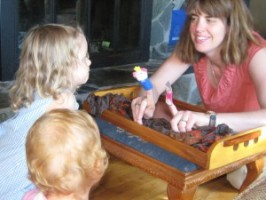
I love using puppets to act out a story. And I love how mesmerized children become while listening to puppets. They are great tools for getting children to listen intently and interact.
I have adapted the following story from a story by Carolina Sherwin Bailey. You can change up the characters to suit the types of puppets you have. For instance, we have a number of animal puppets we like to use sometimes. Alternatively, if you don’t have any puppets you and your child can act out the story together. This also makes a great story on its own.
To do this story as a puppet play you will need the following: four puppets (a boy/girl, mother/father, neighbour/friend and a wise old woman), an apple, a knife (a dull one is safer and works fine for cutting the apple), and a tree branch. I also like using scarfs to make a landscape, and leaves since it is an Autumn story, but these are not necessary.
The Story
The Little House with No Windows and No Doors and A Star Inside.
Once upon a time there was a boy who was tired of playing with his toys and wanted something new to do.
So he asked his mother, “What should I do?”
His mother thought and thought. Finally she told him, “Go and find me a little red and green house [use the same colours as your apple] with no windows or doors and a star inside.”
This really made the boy wonder. His mother usually had good ideas but this one sounded very strange.
“Which way shall I go?” he asked. “I don’t know where to find a red and green house with no windows and no doors and a star inside.”
“Go down the lane, past the farmer’s house and over the hill,” she said. “And then hurry back and tell me all about your journey.”
So the boy put on his jacket and went outside. It was a lovely Fall day and the leaves were starting to change colour and float down to the ground [children may blow around the leaves if you have any].
He hadn’t gone very far up the lane when he saw his neighbour who was working in his yard.
“Hello neighbour!” called the boy. “Do you know where I could find a little red and green house with no windows and no doors and a star inside?”
Well, that’s a mighty strange thing to be looking for!” the neighbour chuckled.
“Why don’t you walk up the lane, past the farmer’s house and ask the old lady who lives at the top of the hill. She’s a very wise woman. I bet she would know.”
So the little boy set off up the road. Soon he came to the house and he knocked on the door. [Knock knoock knock!]
The wise woman answered the door and smiled sweetly at the boy.
“Hello,” she said.
“Hello,” answered the boy. “Do you know where I could find a red and green house with no windows and no doors and a star inside?” he asked. “My mother wants me to find her one and bring it to her.”
“Oh my!” said the wise woman, the lines in her face crinkling with joy. “I would like to find such a house myself. It would be so warm when the frosty nights came. You should go to the orchard and ask the wind. The wind listens at all the chimneys and knows many secrets. I think the wind could tell you. Now off you go!” she said shooing him out the door with a smile.
“Grown ups sure are strange sometimes,” thought the boy. But being a good listener and wanting to please his mother, he went to the orchard.
When he got there he stopped and sat underneath a tree. “Wind,” he called,”could you please tell me where I can find a red and green house with no windows and no doors and a star inside?” [Have children blow like the wind and rustle the tree branch]
He listened for a reply but heard nothing. But then the wind started to blow.
It blew through his hair and through the leaves and suddenly an apple dropped from the tree and fell right into his lap! It was red and green and he could see a little worm inside it.
“Why, this apple is the worm’s house!” he thought. “And it is red and green and there are no doors and no windows!” He lept to his feet. “I think this is what my mother wanted me to find!”
He ran home as fas as he could.
When he got inside he cried, “Mother! I found a red and green house with no windows and no doors, but what about the star inside?”
His mother took the apple from him and smiled. “Watch,” she told him, and she cut that apple in half width-ways and showed him.
“There’s the star inside!” said the boy. “I think it is too pretty not to look at before we eat the apple, don’t you think mother?”
“Yes, indeed,” replied his mother, and they sat down at the table and shared the apple.
It is a nice treat to sit down and eat your apple with your child, but you can also make apple prints with your apple halves.
Apple Print Craft
What you will need: red and green paint, white paper, a shallow dish, apple halves.
Squirt some paint into the dish and press an apple half into each paint blob. Swirl it around a bit to cover the whole apple.
Your apple should look like this:
Press the painted apple onto the paper.
It’s okay if the colours mix a little. It’s all about experimenting and having fun.
The finished projects.
What kinds of stories do you know about fruits or vegetables that you could do a print craft with afterwards?
Introducing Nonfiction into the Lives of Preschoolers
By Dawn Lttle, Links to Literacy, www.linkstoliteracy.com
Children are naturally curious, especially preschoolers. It is through curiosity that children learn. We can foster curiosity, and in turn help children learn, by encouraging and promoting it through nonfiction texts and activities. Here are a few ways to introduce nonfiction into the lives of your preschooler.
- Read Aloud Nonfiction Texts Anytime your preschooler shows an interest in a particular topic, provide nonfiction books on that topic. When you read informational texts aloud to your child (and you don’t have to read nonfiction from cover to cover!), you are building his/her background knowledge.
- Use Environmental Print Provide environmental print for pretend play. For example, if your child is pretending to be a waiter or work in a restaurant, have some take-out menus on hand for him to use. If your child is playing post office, provide him with some junk mail to sort. This can easily turn into a math activity as well. Kids can sort the mail by color or size. When your child turns your family room into a waiting room at the doctor or dentist office, provide magazines and newspapers for him.
- Introduce Text Features If your child has a particular question about a topic, use that time to discuss and show your child a few text features of nonfiction texts. Perhaps he wants to know what a specific dinosaur eats; demonstrate how you can use the table of contents or the index to try to locate the answer quickly, rather than reading through the whole book. If you come upon a word that you know your child will have difficulty understanding, demonstrate how to use a glossary. If there isn’t a glossary, explain to your child what the word means. Briefly, explain how we read differently for different purposes.
- Provide Hands-on Experiences A combination of texts and real-life or hands-on experiences is most powerful for learning. You can use this three-step process to incorporate nonfiction texts into your preschooler’s reading repertoire. Through these steps you will build your child’s background knowledge (essential to comprehending texts).
-
-
- Select a text based on a topic that interests your child.
- Hands-On/Read World – Prior to reading, provide an opportunity for your child to have a hands-on experience of some sort related to the topic. Utilize the outside world as much as possible (outdoors in general, museums, special exhibits, etc.)
- Read Aloud -Read aloud the text asking questions as you read. Provide explanations if you believe your child’s comprehension may be breaking down.
- Connect – Draw comparisons between the experience the child had and the text. How are they alike? How are they different? Help your child make connections.
-
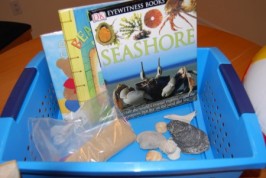
- Create Discovery Baskets Discovery Baskets are made up of items related to a topic. Items that can provide a hands-on experience for a child, as well as texts related to that topic (you can use both fiction and nonfiction) are placed in a basket. Discovery Baskets are great to use if you want to build background knowledge prior to a new experience.
- Example: Prior to making our annual beach trip, I wanted to build my kids’ background knowledge about the beach. Our Discovery Basket included: shells, a bag of sand, several books about shells, and a custom made inflatable beach ball. Our Hands-on Experience included feeling and discussing the different shells, counting the shells, and sorting the shells by size (another math lesson!). We put our hands in the bag and felt the sand. We discussed how it felt. We also created a craft. We bought an inexpensive wooden frame and then I hot glued the shells on to the frame. Although the frame could have been painted, my children chose not to paint the frame. We then had a frame for a picture from our trip. Then we moved on to reading about shells. Finally, we discussed how our shells were similar or different from the shells in the books. We used the beach ball to toss back and forth. The ball had comprehension statements to help us connect our background knowledge with our textbook knowledge. If I had a beach bucket large enough to fit hard cover books, I would have used that as our “basket.”

Reading nonfiction texts with preschoolers provides a natural connection to their own curiosities about the world. Having background knowledge about topics helps children comprehend what they read. By building upon the world knowledge of your preschooler now, you are setting a foundation that will only serve to guide them when they begin reading on their own.
Kids love to receive their own mail. Here are a few nonfiction magazine subscriptions that are fun to read with preschoolers:
Filled with bright colors and interactive stories

http://www.nwf.org/kids/kzPage.cfm?siteid=1

Filled with lively photographs and engaging stories to develop pre-reading skills
http://kidsblogs.nationalgeographic.com/littlekids/parents.html
Full-color photos and simple interactive text that prompts discussion and active learning
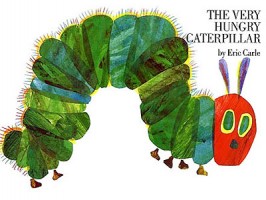
Happy Anniversary Hungry Caterpillar!

We love Eric Carle at my house. Do you? Did you know that it’s the 40th Anniversary of The Very Hungry Caterpillar? Yay! So, in Mr. Carle’s honor, join me for an author study by reading, his most famous book, The Very Hungry Caterpillar then, write and illustrate a book of your own.
Read: **The Very Hungry Caterpillar, and if you have more time, read: The Grouchy Ladybug, The Mixed-up Chameleon, A House for Hermit Crab, The Very Quiet Cricket and Little Cloud
Talk:
What are Eric Carle’s Main Characters? (Bugs, Animals, Nature?)
What does the hungry caterpillar do on his adventure?
If you wrote a book like Eric Carle’s, what would your main character be?
What would your character do on his or her adventure?
Why don’t you write a book like Mr. Carle?
Write:
Print out this story template. Like the Caterpillar story, this sequences events by the days of the week – Monday through Sunday. You (taking dictation) or your child fill in the blanks. Add to it, rewrite, make it your own. It’s just a starting point.
Illustrate: (in Eric Carle style of course)
Watch Carle’s Picture Writer video — which is out of print, usually found at a library — or see his gallery of online slide show projects.
Create an Eric Carle inspired illustration.

Materials:
Finger paints, tempura paints or water colors (whatever you have)
paint brushes
plastic comb, old toothbrush, fork, etc.
smock, newspapers, play clothes for painting
- Make a background– use the middle to separate the ground from the sky (drag a comb or toothbrush to make lines across the wet paint) Encourage your child to make the ground darker than the sky to show the separation.

- Paint several more sheets in different colors. Use a straw to splatter the paint or drag a comb, fork or toothbrush for texture.

- Let the sheets dry overnight.
- Cut out your story’s main character from one of the extra painted sheets. (My daughter cut out a pink cat which might not be obvious to anyone but her.)
- Glue it onto the background.
- Cut out a sun, trees, and other details to decorate the background. Glue. Any story details you want to add? Something from the adventure? Cut. Glue.
- Let it dry.
- Display the story and illustration together. Congratulations! You did it!
I hope Eric Carle’s work inspires imaginative creations! For more information on his life, watch this interview from Reading Rockets. Thank you, Allison for allowing me to contribute to your amazing blog. I, like all your readers, am a huge fan!
___________________________________________________________________________________________
Melissa Taylor is a mom, freelance writer, and teacher. She created and writes Imagination Soup to give parents fun learning activities to do with their kids. Find her on Twitter at www.twitter.com/imaginationsoup.